
You have reviewed the financials. Revenue looks stable. Margins are reasonable. The seller’s broker has assembled a tidy package of tax returns, P&L statements, and a narrative about community reputation. None of it tells you what you actually need to know: who calls this funeral home, when they call, how fast someone picks up, and what happens next.
The first-call log does. It is the most granular operational dataset in any funeral home, and it sits in plain sight — usually in a binder on the arrangement office desk or in the funeral management software under a tab nobody thinks to password-protect. Sellers rarely restrict access to it because they don’t think of it as sensitive. It’s operational, not financial. That distinction works in your favor.
If you are conducting due diligence on a funeral home acquisition and you haven’t reviewed the first-call log entry by entry, you are building your financial model on someone else’s summary. This guide shows you how to read it, what to extract from it, and how to use it as a negotiation tool.
What the First-Call Log Is and Why It Matters More Than the P&L
The funeral home’s operational black box
The first-call log — sometimes called the intake record, first-call sheet, or removal log — is the chronological record of every death call a funeral home receives. Every time a family, hospice nurse, hospital social worker, nursing home, or medical examiner calls to report a death and request services, someone at the funeral home creates a first-call entry.
A typical entry contains:
- Date and time of the call
- Caller name and relationship to the decedent (spouse, adult child, hospice coordinator, hospital discharge planner)
- Decedent information — name, date of birth, date of death, Social Security number
- Location of death — private residence, hospital, nursing facility, hospice house, medical examiner’s office
- Referral source — how the caller found or chose this funeral home
- Service type initially requested — traditional burial, cremation, direct cremation, graveside service, memorial service, immediate need vs. preneed fulfillment
- Staff member assigned to the removal and/or arrangement
- Notes — special circumstances, religious requirements, out-of-state transfer needs, family dynamics
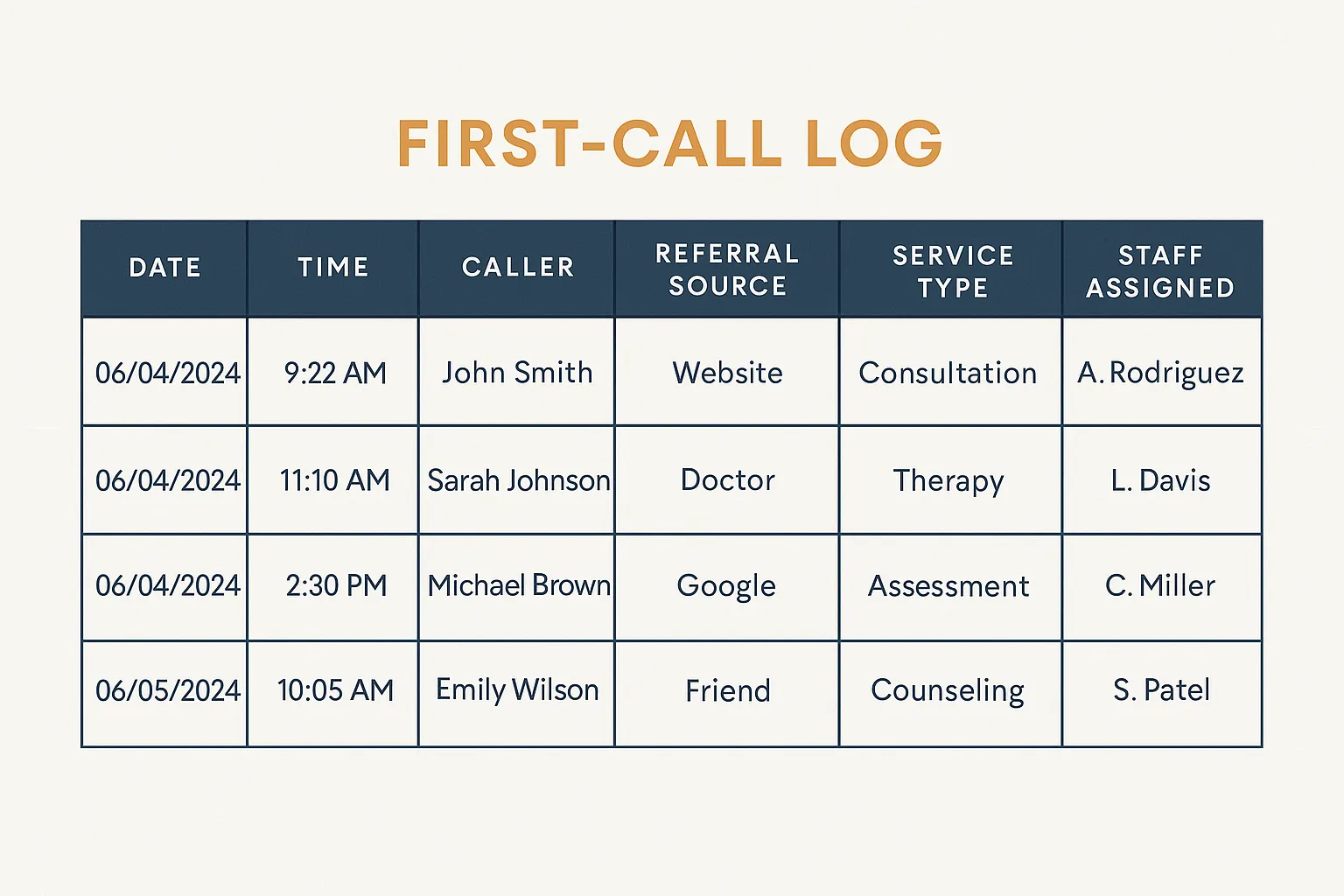
This is not a financial document. It is an operational document. And that is exactly why it is so valuable — it records what actually happened before anyone had a reason to present it favorably.
Why sellers don’t think to restrict it
Financial records are curated. Tax returns are prepared by accountants who understand they may be reviewed. P&L statements are formatted for presentation. Even arrangement logs — the records of services sold — are summaries filtered through the lens of revenue.
The first-call log is none of these things. It is a working document maintained by whoever answers the phone at 2:00 AM. It contains the unfiltered operational reality of the business. Misspellings, shorthand notes, crossed-out entries, gaps — all of it tells a story.
Ask for it early. Ask for it casually. Frame it as needing to understand operational workflows. You will learn more from three years of first-call logs than from five years of tax returns.
Verifying Case Volume — The Hard Way
Count entries yourself
Do not rely on seller summaries. Do not accept a number the broker provided. Sit down with the first-call log — physical or digital — and count.
Count every entry for each of the past three years, minimum. Five years is better. You are looking for:
- Total annual case count — does it match what the seller and broker have represented?
- Monthly distribution — is volume consistent month to month, or are there seasonal patterns?
- Year-over-year trend — is volume growing, stable, or declining?
A simple tally by month and year will take you an hour or two for a 200-call-per-year firm reviewing three years. That is an hour that can save you six figures.
Cross-reference with the P&L
Once you have your independent case count, compare it against monthly and quarterly revenue on the P&L. Calculate the implied average revenue per case.
If the seller reports 250 cases and $1.5 million in revenue, the implied average is $6,000 per case. If your first-call log count shows 220 cases, the implied average jumps to $6,818 — or the seller’s revenue figure includes something other than at-need service revenue (preneed contract sales, merchandise-only transactions, cash advances passed through).
Either way, the discrepancy tells you something important. Chase it down.
Watch for gaps
Missing entries are a signal. Look for:
- Days with no calls during periods that should have activity (a 200-call firm averages roughly 4 calls per week — a week with zero is unusual, two consecutive weeks is a red flag)
- Missing months or quarters
- Periods where the log format changes abruptly (suggesting a switch in who was maintaining it, or a gap that was backfilled)
Distinguish trade services from own cases
Funeral homes routinely perform trade services — removals, embalming, or facilities use — on behalf of other funeral homes. These may appear in the first-call log but do not represent the firm’s own client families.
Learn to identify trade entries. They’re usually coded differently, reference another funeral home by name, or note “trade service” or “trade call” in the entry. Separate them from the count. A firm reporting 250 cases that includes 30 trade services is really a 220-case operation.
For a deeper dive into independent volume verification methods, including using government vital statistics databases, see our guide on verifying case volume through public death records.
Mapping Referral Sources
Categorize every call by source
The first-call log’s referral source field — or the information you can infer from the caller identity and death location — lets you build a referral map of the entire business. Go through the log and categorize each call into one of these channels:
- Hospice — calls from hospice nurses, social workers, or coordinators
- Hospital — calls from hospital discharge planners, chaplains, or ER staff
- Nursing home / assisted living — calls from facility staff
- Direct family call — family found the firm on their own (online, drove past, word of mouth, repeat family)
- Medical examiner / coroner — cases referred by the ME or coroner’s office
- Clergy / faith community — referral from a pastor, priest, rabbi, imam, or other religious leader
- Other funeral home — trade service or transfer
- Unknown / not recorded — the log doesn’t indicate a source
Calculate concentration
Once categorized, calculate what percentage of total volume each source represents. Then look at individual entities within each category. “Hospice” as a category might be 25% of volume — that’s manageable. But if one hospice organization within that category accounts for 20% by itself, you have a concentration problem.
The threshold to watch: any single referral source accounting for more than 25% of total call volume is a material risk. That relationship is propping up the business, and it may not survive an ownership transition.
For a comprehensive framework on evaluating this risk and structuring your deal around it, read our referral source concentration risk guide.
Analyze trends over time
Don’t just look at the current year. Map referral sources by year for the past three to five years. You are looking for:
- Sources that have disappeared — a hospice that used to send 30 calls a year and now sends zero. What happened?
- Sources that are growing — a nursing home that tripled its referrals after a new administrator arrived. Is that relationship stable?
- Seasonal shifts — some referral sources have seasonal patterns (snowbird communities, for example, show dramatic seasonal volume swings)
- The cremation/burial mix by referral source — hospice referrals tend to skew more heavily toward cremation than direct family calls. As your referral mix shifts, so does your service mix and revenue per case.
Operational Intelligence Hidden in the Log
The first-call log is not just a counting tool. Read it carefully and it reveals the operational DNA of the business.
Response time patterns
Many first-call logs record both the time of the call and the time of the removal (when the funeral home’s staff arrived to transport the decedent). The gap between these two timestamps is the response time — and it is one of the most important service metrics in death care.
- Response times under 60 minutes suggest a well-staffed, operationally tight firm
- Response times consistently over 90 minutes may indicate understaffing, geographic overextension, or operational apathy
- Response times that have gotten worse over time suggest burnout, staffing losses, or a disengaged owner
Families and referral sources remember response times. Hospice nurses who wait two hours for a removal team will start calling someone else. This is volume loss that never shows up in the financials until it’s already happened.
Staff assignment patterns
Who handles the calls? If the log shows one person assigned to 60% or more of removals and arrangements, you have a key-person dependency. That individual — often the owner — is the operational backbone of the business.
Key-person risk matters because that person may not be staying. Even if they agree to a transition period, their relationships, habits, and institutional knowledge are leaving with them eventually. For more on evaluating whether the business can function without its central figure, see our guide on the owner absence test.
Service type mix evolution
Track the service type field over time. You are building a cremation-versus-burial trend line from actual operational data — not from the seller’s verbal estimate, not from the NFDA’s national statistics, but from this specific funeral home’s actual cases.
If cremation was 40% of volume three years ago and is 55% today, your revenue-per-case projections need to reflect that trajectory, not the current snapshot. Cremation cases typically generate 40–60% less revenue than traditional burial cases. A rising cremation rate is a revenue headwind your financial model must account for.
Geographic patterns
The death location field tells you where the funeral home’s service area actually is — not where the seller says it is, but where the calls actually come from.
Plot the death locations on a map. You’ll see the firm’s true geographic footprint: the core service area where most calls originate, the fringe areas where it occasionally reaches, and the gaps where competitors are dominant.
If you see the geographic footprint contracting over three to five years — fewer calls from outlying areas, volume concentrating closer to the facility — the firm may be losing ground to competitors on the periphery.
After-hours call volume
Count the calls that come in between 6:00 PM and 8:00 AM, and on weekends. In most funeral homes, 40–50% of first calls arrive outside normal business hours.
This number directly drives your on-call staffing costs. A firm averaging one after-hours call per night needs different staffing than one averaging three. The first-call log tells you exactly what your on-call burden will be — and whether the seller’s current staffing model is sustainable or whether the existing staff is burned out.
Red Flags and What to Do About Them
Volume anomalies
- Sudden volume spikes — A quarter where volume jumps 30% above trend deserves investigation. Was there a local event (nursing home closure, competitor closing, natural disaster)? Was it a one-time anomaly or a structural shift? COVID-era spikes (2020–2021) distort trend lines significantly — normalize for them.
- Sudden volume drops — More concerning. Did a referral source leave? Did the funeral home lose a key staff member? Did a competitor open nearby? The seller may not volunteer this information. The log will show it.
- Gradual decline — The most dangerous pattern because it’s easy to rationalize. If volume has dropped 5–8% per year for three consecutive years, that is a trend, not a blip. See our guide on evaluating funeral homes with declining case volume for a framework on whether the decline is reversible.
Logging inconsistencies
- Entries with minimal information — A first-call log that consistently lacks referral source data, service type, or staff assignment suggests sloppy operational management. If the owner doesn’t care enough to maintain clean records, what else is being neglected?
- Format changes — If the log switches from detailed entries to sparse notes at a specific point, find out why. Staff change? Software change? Owner checked out?
- High rates of “other” or “pending” service types — If 20% or more of entries are coded as “other,” “pending,” or left blank for service type, the log may have been maintained retroactively or incompletely. This undermines your ability to analyze the cremation/burial mix.
What to ask the seller
When you find anomalies, don’t accuse. Ask operational questions:
- “I noticed volume dropped noticeably in Q3 of 2024. Was there anything going on operationally around that time?”
- “The referral source field is blank for a lot of entries in 2023. Did the tracking process change?”
- “It looks like most removals were handled by two people. Is that still the case, or has staffing shifted?”
These are reasonable questions. A seller who gets defensive about them is telling you something. A seller who answers them straightforwardly is confirming that the data is what it appears to be.
Integrating First-Call Data Into Your DD Package
Building a working spreadsheet

Take the raw first-call log data and organize it into a spreadsheet with the following columns:
- Date
- Day of week
- Time of call
- Referral source (categorized)
- Specific referral entity (e.g., “Sunrise Hospice” rather than just “hospice”)
- Service type (cremation, traditional burial, direct burial, graveside, memorial, trade service)
- Death location type (residence, hospital, nursing home, hospice house, other)
- Staff member assigned
- Response time (if available)
This spreadsheet becomes your analytical foundation. From it, you can generate every metric your lender, QoE analyst, and your own financial model need.
Key metrics to calculate
Present these to your lender and advisory team:
- Average monthly case volume (excluding trade services) and trend line
- Referral source concentration — top 5 sources as percentage of total volume
- Cremation rate and year-over-year trend
- Average response time and trend
- After-hours call percentage
- Staff utilization — cases per staff member
- Geographic distribution — percentage of cases by county or zip code
How QoE teams use this data
A Quality of Earnings analyst will use your first-call data to:
- Verify revenue per case against the P&L (does the case count times average revenue equal reported revenue?)
- Identify non-recurring volume (COVID spikes, one-time events)
- Assess sustainability of referral relationships
- Model forward volume under various scenarios (loss of top referral source, continued cremation rate growth)
If you haven’t already engaged a QoE team, this data package makes their job dramatically easier and your report more credible. The SBA’s standard operating procedures for business acquisition loans expect lenders to assess the sustainability of historical earnings — your first-call analysis directly supports that requirement.
Negotiation leverage
First-call log analysis gives you specific, defensible data points for negotiation:
- Declining volume trend supports a lower multiple or purchase price adjustment
- High referral concentration justifies an earnout structure tied to volume retention post-closing
- Rising cremation rate justifies a revenue-per-case adjustment in your projections
- Key-person dependency visible in staff assignment data supports requiring a longer seller transition period
You are not arguing with the seller’s version of events. You are presenting data from their own records that supports a different valuation conclusion. That is a fundamentally stronger negotiating position than relying on “industry comparables” or gut feeling.
For a comprehensive checklist of everything to review beyond the first-call log, see our funeral home due diligence checklist.
Frequently Asked Questions
What if the funeral home doesn’t maintain a first-call log?
Every funeral home maintains some version of intake records — it’s operationally impossible to run the business without them. The format varies. Older firms may use handwritten removal logs. Software-based firms will have the data in their funeral management system (NFDA’s technology resources discuss common platforms). If the seller claims they have no intake records, that is a red flag significant enough to reconsider the transaction.
How far back should I review?
Three years minimum. Five years is ideal, especially if you need to normalize for COVID-era volume distortions. If the seller has been in business for decades, you don’t need the full history — but you need enough to establish a reliable trend line.
Can I get this data during the pre-LOI phase?
Usually not in detail. The first-call log contains decedent personal information, so sellers and brokers typically restrict access until a Letter of Intent is signed and due diligence formally begins. However, you can ask for summary statistics (monthly case counts by year, cremation vs. burial breakdown) pre-LOI. If the seller refuses to provide even summary volume data before LOI, proceed with caution.
What software systems should I expect to see?
Common funeral management platforms include FIMS, Passare, FrontRunner, Osiris, and Halcyon. Each stores first-call data differently, but all of them capture it. Ask the seller to export the data or give you direct read-only access to the system during due diligence. The International Cemetery, Cremation and Funeral Association (ICCFA) maintains resources on technology standards in the profession.
This guide is part of the Funeral Home Buyer resource library — acquisition intelligence for serious buyers, from due diligence through operations.
Funeral Home Buyer provides educational content for professionals evaluating business acquisitions in the funeral services industry. This article is not legal, financial, or investment advice. Consult qualified professionals before making acquisition decisions.