
You’re ready to buy a funeral home. You’ve read about valuations, preneed trusts, and SBA lending. You’ve maybe even identified a few targets. But before you make a single call to a seller or broker, there’s a question you need to answer honestly: who is on your team?
Not your spouse. Not your business partner. Your professional deal team — the attorney, accountant, broker, and consultant who will protect you from the mistakes that sink funeral home acquisitions. The ones who know what a preneed trust shortfall looks like buried in a balance sheet, or why a state licensing transfer can delay your closing by three months if nobody flags the requirements early enough.
Most acquisition guides skip this step entirely. They assume you already have these people. You probably don’t — not the right ones, anyway.
Why You Can’t Use Your Regular Attorney (and Other Expensive Mistakes)
Here’s a scenario that plays out several times a year in funeral home M&A: a buyer hires a capable business attorney — someone who’s closed 40 or 50 small business acquisitions. Restaurants, medical practices, manufacturing firms. Good attorney. Experienced. Responsive.
The deal closes. Three months later, the buyer discovers that $380,000 in preneed trust obligations are underfunded. The seller’s representations in the purchase agreement didn’t address preneed trust adequacy because the attorney didn’t know to include that language. The indemnification clause — if there is one — doesn’t specifically cover preneed shortfalls.
The buyer is now $380,000 poorer than they thought. And they’re paying their attorney again to figure out whether they have any recourse.
The generalist trap
A business attorney who has never handled a funeral home transaction doesn’t know what they don’t know. Funeral homes are regulated at the state level by agencies that don’t regulate anything else. The assets — preneed trusts, funeral director licenses, cemetery plots — don’t appear in any other type of business sale.
Here’s what a generalist will typically miss:
- Preneed trust compliance. Every state regulates preneed trusts differently. Deposit requirements, withdrawal rules, trustee obligations, reporting standards — these vary wildly. An attorney who doesn’t know the specific requirements in your state can’t evaluate whether the seller’s preneed book is in compliance, let alone negotiate protections for you if it isn’t.
- State licensing transfer requirements. Funeral home licenses don’t transfer automatically in most states. Some require new applications. Some require the buyer to hold a funeral director’s license personally. Some have waiting periods, facility inspections, or board hearings. Miss a requirement and your closing date moves — or the deal dies.
- Environmental liability. Older funeral homes may have underground storage tanks, formaldehyde exposure issues, or embalming waste disposal concerns. In some states, the buyer assumes environmental liability on close unless the purchase agreement specifically addresses it.
- Funeral-specific tax treatment. The allocation of purchase price across funeral home assets — particularly goodwill, preneed contracts, and non-compete agreements — has death-care-specific implications that a generalist CPA and attorney will handle incorrectly or suboptimally.
The real cost of the wrong advisor
These risks show up regularly: deals that close with unaudited preneed books and hundreds of thousands in unfunded obligations. Licensing transfers that weren’t initiated before closing. Environmental indemnification clauses too narrow to protect the buyer. Purchase price allocations that left six figures in tax deductions on the table.
Each mistake costs more to fix after closing than it would have cost to hire the right advisor before the LOI.
The four roles you need
A properly assembled funeral home acquisition team includes four types of professional:
- M&A attorney with funeral home transaction experience
- Industry CPA who understands death care financials
- Funeral home broker (in most situations)
- Industry consultant (situational, but valuable for first-time buyers)
Each serves a distinct function. None can substitute for the others.
Timing matters more than you think
The biggest mistake isn’t hiring the wrong advisor. It’s hiring the right one too late.
You need your attorney and CPA before you start actively pursuing deals. Not after you find a target. Not after you sign an LOI. Before. They should be shaping your search criteria, reviewing opportunities you’re considering, and advising on deal structure from day one.
If you’re already in diligence and assembling your team on the fly, you’re behind. You can still catch up, but every week of delay increases the risk that you’ll miss something that should have been caught in the first pass.
The M&A Attorney: Your First Call

Your attorney is the single most important hire in the deal team. Not because attorneys are more important than accountants — they’re not, in many contexts — but because the attorney’s work touches every phase of the transaction and the consequences of errors are the most severe.
What a funeral-home-experienced attorney does differently
- Preneed trust review. They know what trust documents should look like, what state-specific compliance requirements apply, and what representations to demand from the seller regarding trust adequacy.
- Licensing transfer. They’ve handled state board applications before. They know the timeline, documentation, and common delays. In states requiring the buyer to hold a personal funeral director’s license, they’ll flag this before you’ve invested months in a deal you can’t close.
- Death-care-specific reps and warranties. The purchase agreement needs to cover preneed trust funding adequacy, funeral board compliance, outstanding preneed contract status, crematory licensing, and environmental conditions specific to funeral operations. A generalist attorney won’t include these.
- Environmental indemnification. They’ll assess whether the property carries environmental risks based on age and operations, then draft indemnification that actually protects you.
- Non-compete and transition provisions. In funeral service, the seller’s relationships with families, hospices, churches, and clergy are the business. Your attorney needs to prevent the seller from pulling volume to a new operation.
How to find one
Funeral home M&A attorneys are a small community. Start with these channels:
- State funeral directors association. Call and ask who represents buyers and sellers. They’ll know the two or three firms that handle most deals in your state.
- ICCFA member directory. The International Cemetery, Cremation and Funeral Association maintains a vendor directory including death care transaction attorneys.
- National firms with death care practices. Firms like Faegre Drinker and others maintain dedicated funeral and cemetery practices, typically handling larger or more complex transactions.
- Regional specialists. In many states, one or two smaller firms handle most funeral home transactions. Your broker or state board contact can point you to them.
- Other funeral home owners. Word of mouth is the most reliable referral channel in this industry.
What to ask in the initial consultation
Qualify them the same way they’ll qualify you:
- How many funeral home transactions have you handled? Fewer than five should give you pause. Fewer than two and you’re paying for their education.
- What’s your experience with preneed trust issues? This is the litmus test. If they can speak fluently about trust funding adequacy and how preneed obligations flow through a purchase agreement, they’re credible.
- Are you familiar with licensing requirements in my state? An attorney who’s done 20 deals in Ohio may not know the first thing about transferring a license in Florida.
- What does your typical engagement look like? Will they be hands-on throughout, or does your file get handed to a junior associate?
- Who else have you worked with? A connected attorney will have CPA, broker, and lender referrals. That network is valuable.
Expected cost range
For a typical single-location acquisition, expect legal fees of $15,000 to $40,000. Straightforward deals with clean preneed books land at the low end. Complex preneed issues, multi-entity structures, or contentious negotiations push toward the high end.
If someone quotes significantly below $15,000, they’re either inexperienced (and underestimating the work) or planning to cut corners. Don’t negotiate this fee aggressively. A good funeral home M&A attorney can save you six figures.
The Industry CPA: Reading the Numbers Nobody Else Can

Funeral home financials look like small business financials — until you try to analyze them. Then they turn into a specialized accounting exercise that will mislead a generalist CPA in predictable and expensive ways.
Why funeral home financials are different
Four characteristics trip up generalist accountants:
- Cash vs. accrual confusion. Many independent funeral homes run cash-basis accounting. That works for tax returns but distorts the valuation picture — especially when preneed contracts mature and services pre-sold years ago are fulfilled today.
- Preneed trust accounting. Preneed trusts typically sit off the balance sheet, managed by a third-party trustee. A generalist CPA sees no red flags. An industry CPA asks: where’s the trust statement, what’s the funding ratio, and who’s the trustee?
- Merchandise cost tracking. Many operators track casket, urn, and vault costs poorly — ordering in bulk, expensing on receipt, never reconciling inventory to sales. Gross margins can look wildly different depending on whether you’re reading real numbers or the owner’s approximation.
- Owner compensation normalization. A funeral home owner who is also the funeral director, embalmer, on-call night manager, and maintenance person is doing four jobs. What their labor is actually worth at market rates is critical to calculating true earnings.
What an industry CPA catches that a generalist misses
- Underfunded preneed trusts disguised as healthy books. The funeral home’s P&L looks fine. Revenue is stable, margins are adequate. But the preneed trust is 70% funded against current cost obligations. That gap is a liability you’re buying. A generalist CPA won’t see it because they won’t know to look for it.
- Inflated discretionary expenses. Funeral home owners commonly run personal expenses through the business — vehicles, travel, meals, family member salaries. These “add-backs” inflate the seller’s discretionary earnings (SDE) and, by extension, the asking price. An experienced CPA knows which add-backs are legitimate in funeral home transactions and which are aggressive.
- Deferred maintenance hidden in low capex. A funeral home showing 2% of revenue in annual capital expenditures isn’t necessarily efficient — it may be falling apart. An industry CPA knows what a funeral home should spend annually on vehicle replacement, facility upkeep, and equipment. If the numbers are suspiciously low, they’ll flag deferred maintenance as a hidden cost.
- Case mix trends that undermine the valuation. Revenue might be flat, but if the cremation rate is climbing and the owner has been raising prices to compensate, that trend has a ceiling. A CPA who understands death care economics will model the case mix trajectory into the adjusted earnings analysis.
Where to find one
- Federated Funeral Directors of America provides accounting services for funeral homes and can refer experienced practitioners.
- Mid-market firms like Katz, Sapper & Miller in states with high concentrations of independent funeral homes often have partners with death care experience.
- Solo practitioners in funeral home-heavy states (Pennsylvania, Ohio, Texas, California) develop specialties through decades of serving the local industry.
Your broker and attorney will also have CPA referrals. The funeral home M&A ecosystem is small enough that the good professionals all know each other.
The adjusted EBITDA / SDE conversation
The central financial question in any acquisition is: what are the true, normalized earnings? In funeral homes, the answer depends on Seller’s Discretionary Earnings (SDE) — pre-tax profit plus owner compensation, discretionary expenses, non-recurring items, and non-cash charges.
The add-back conversation gets contentious. Legitimate add-backs include owner compensation above market-rate manager cost, personal expenses run through the business, and above-market rent on owner-held real estate. Aggressive add-backs include assuming the buyer will perform all four roles the current owner fills, treating deferred maintenance as “discretionary,” and ignoring the preneed funding gap.
Your CPA should build or validate the adjusted earnings analysis independently. Don’t let the seller’s broker control this number unchallenged.
Expected cost range
Expect CPA fees of $5,000 to $15,000 for transaction-specific due diligence: financial statement review, adjusted earnings analysis, preneed trust reconciliation, tax structure advisory, and working capital analysis. Post-closing accounting setup adds $3,000 to $8,000.
The Funeral Home Broker: Matchmaker, Gatekeeper, or Both?
A handful of firms control access to most listed opportunities, many of the best deals never hit the market, and the broker nearly always works for the seller. Understanding this landscape prevents two common mistakes: overpaying for access you didn’t need, or dismissing relationships that would have surfaced your best opportunities.
When you need a broker vs. going direct
You need a broker when you don’t have existing relationships with funeral home owners, you want access to listed opportunities with structured processes, you’re searching across multiple states, or you’re a first-time buyer who needs the credibility a broker introduction provides.
You may not need one when you have a direct relationship with a willing seller, you’ve found an off-market opportunity through your own network, or the seller approached you directly with no broker involved.
Either way, you still need your attorney and CPA. A broker is a deal origination channel, not a substitute for professional advisors.
The major players
- NewBridge Group. Largest dedicated funeral home brokerage in the U.S. Exclusively death care. Largest listing inventory and buyer database. Start here.
- Johnson Consulting Group. Full-service firm: brokerage, valuation, and consulting. Strong in the independent market. They handle both buyer and seller engagements — understand the potential conflicts.
- Foresight Companies. Primarily consulting and strategic advisory, but they facilitate transactions. Strong for complex or multi-location deals.
- SELECTED Independent Funeral Homes Acquisition Marketplace. Membership organization connecting member sellers with qualified buyers.
Regional firms matter too, particularly in Texas, Pennsylvania, Ohio, and the Southeast, where they handle deals that never reach national firms. For a deeper dive on broker selection, see our complete broker guide.
Buyer-side vs. seller-side representation
The point most first-time buyers miss: the broker almost always represents the seller. The seller hired them. The seller pays their commission. The broker’s obligation runs to the seller.
This doesn’t make them adversarial — good brokers want clean deals. But it means the broker’s valuation opinion serves the seller, information has been curated by or for the seller, and the incentive is to close at the highest price. Verify every financial representation independently through your own CPA.
Buyer-side brokerage exists but is rare. If you want a true buyer’s agent sourcing off-market deals, expect a retainer plus success fee.
Fee structures
Commissions typically run 8% to 12% of the transaction value, paid by the seller at closing. On a $2 million deal, that’s $160,000 to $240,000. Deals above $5 million often see commissions drop to 5–8%.
The commission comes from the seller’s proceeds, not your pocket — but it’s baked into the asking price. The seller prices to net 88–92 cents on the dollar. As a buyer, you typically pay the broker nothing directly, but the commission cost is embedded in the economics of every listed deal.
The Industry Consultant: Optional but Valuable
Not every deal needs a consultant. But for first-time buyers — particularly those entering death care from outside the industry — a targeted consulting engagement can prevent operational mistakes that no attorney or CPA would catch.
What a consultant adds beyond your broker and CPA
Your attorney protects you legally. Your CPA protects you financially. A consultant protects you operationally — evaluating whether you’ll actually succeed running this business after you close.
- Operational assessment. Staffing efficiency, workflow bottlenecks, facility condition, and whether the layout serves modern families.
- Market analysis. Competitive landscape, population trends, realistic growth potential, and whether current call volume matches what the market should support.
- Growth planning. Quick wins like cremation gardens, reception venues, or underserved demographics that could increase revenue per call.
- Integration strategy. How to transition ownership without losing families, staff, or community trust.
When it’s worth the investment
- You’re entering death care from outside the industry. A consultant bridges the operational knowledge gap during evaluation and transition.
- The deal involves a multi-location operation. More locations means more variables in staffing, facility condition, and management infrastructure.
- The operation has turnaround potential. A consultant can assess whether declining volume or deferred maintenance is fixable and help you build an operational plan.
- You want a second opinion. Sometimes you need an experienced operator to look at the whole picture and tell you what they see.
Firms and individuals
- Foresight Companies — the largest death care consulting firm in North America. Most often engaged for complex or high-value transactions.
- Your Funeral Coach (Jason Underwood) — works specifically with independent funeral home owners on operations and growth.
- American Funeral Consultants and similar regional practices — targeted assessments at lower price points.
- Retired funeral home owners who do informal consulting. Some of the best operational advice comes from people who ran funeral homes for 30 years. Your state association can make these connections.
Expected cost
For a targeted operational assessment — site visit, staff interviews, market analysis, and written recommendations — expect $3,000 to $10,000. The low end covers a focused assessment by a solo consultant. The high end reflects a comprehensive engagement by a national firm with detailed market analysis and integration planning.
For ongoing consulting during the transition period (first 90 days post-closing), budget an additional $5,000 to $15,000.
Assembling the Team: Timeline and Coordination
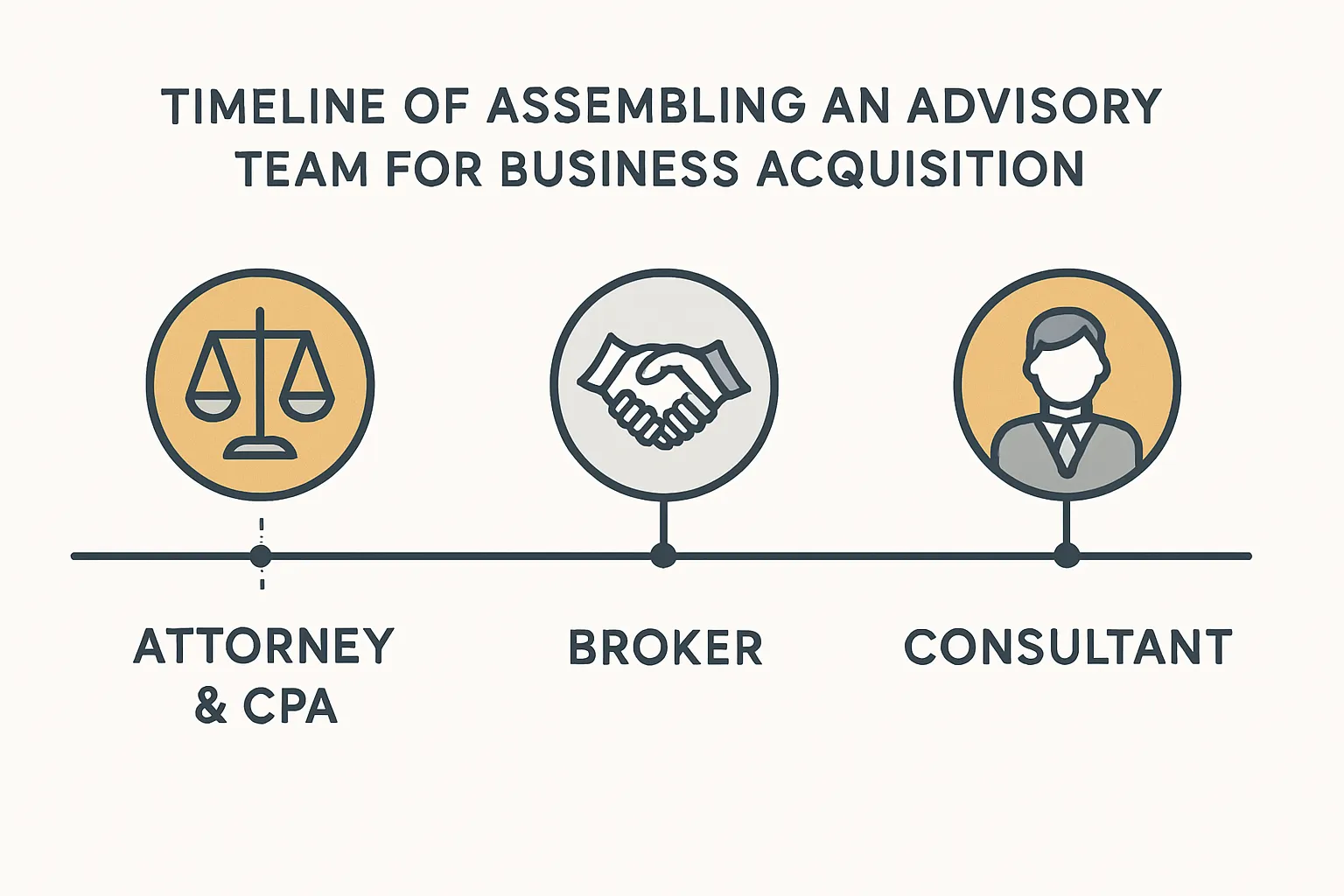
Knowing who you need is only half the problem. Knowing when to engage them — and how they work together — is what separates buyers who close smoothly from buyers who scramble through every phase.
The ideal sequence
Phase 1: Before you start looking. Engage your attorney and CPA first. Interview two or three of each, select one, establish engagement terms, and brief them on your acquisition criteria. Ask them to help build your due diligence checklist.
Phase 2: Active search. Build broker relationships. Register with NewBridge Group, Johnson Consulting, and regional firms in your target markets. Share your criteria, sign NDAs as opportunities come in, and loop your CPA on every set of financials — even deals you pass on. The pattern recognition is valuable.
Phase 3: Deal-specific engagement. Bring in a consultant if the deal warrants it. Commission an operational assessment, coordinate the site visit, and integrate findings into your go/no-go decision.
How these roles interact during a deal
Your advisors shouldn’t work in silos. The broker facilitates deal access and information flow. Your CPA reviews financials, builds the adjusted earnings analysis, and advises on deal structure. Your attorney drafts the LOI, negotiates the purchase agreement, handles licensing transfers, and manages closing. The consultant (if engaged) assesses operations and plans the transition.
Critical: let your attorney and CPA talk directly. They’ll coordinate on purchase price allocation, deal structure, and financial representations. Don’t make yourself the relay — that slows things down and introduces errors.
Total advisory cost budget
For a typical single-location funeral home acquisition in the $1 million to $4 million range, plan for total advisory costs of $25,000 to $70,000:
| Advisor | Cost Range |
|---|---|
| M&A Attorney | $15,000–$40,000 |
| Industry CPA | $5,000–$15,000 |
| Broker fees (buyer-side, if applicable) | $0–$5,000 |
| Industry Consultant | $3,000–$10,000 |
| Total | $23,000–$70,000 |
That’s 2–5% of the transaction value. Compare it to the cost of a single material mistake — a $200,000 preneed shortfall, a $150,000 environmental remediation, a tax structure that costs you $400,000 in deductions over 15 years — and the math is obvious.
This is the cheapest insurance you’ll buy in the entire acquisition process.
The red flag you can’t ignore
Be wary of any advisor who discourages you from hiring the others. An attorney who says you don’t need an industry CPA is either arrogant or ignorant. A broker who says you don’t need your own attorney is protecting the deal, not you.
Good professionals know their lane. They welcome the scrutiny other advisors bring. If someone on your team is trying to be the only voice in your ear, replace them.
Frequently Asked Questions
How early should I start building my deal team?
Two to three months before you plan to actively pursue opportunities. Your attorney and CPA need time to understand your situation, and you need time to vet them.
What if I can’t find a funeral-home-experienced attorney in my state?
Look regionally. A death care attorney two states away with 30 transactions is better than a local attorney handling their first. Most legal work is done remotely. For licensing transfers, if your attorney lacks state-specific experience, they’ll need local co-counsel.
Can one firm handle both legal and accounting work?
No. You want independent perspectives and the checks and balances that come from separate firms with separate interests in the deal.
Do I need all four advisors for a deal under $500,000?
You need the attorney and CPA regardless of deal size. A $400,000 funeral home has the same preneed trust issues, licensing requirements, and tax considerations as a $4 million one. The broker and consultant are more situational at lower price points.
What if the seller’s broker says their attorney can handle closing for both sides?
Walk away from that suggestion. Dual representation in an acquisition is a conflict of interest, full stop. You need your own attorney.
How do I evaluate whether my current CPA can handle this?
Ask three questions: Have you worked on a funeral home transaction? Can you explain how preneed trust obligations affect adjusted earnings? Do you know how to handle Section 197 amortization of funeral home goodwill? If they can’t answer all three confidently, they’re not the right CPA for this deal.
This guide is part of the Funeral Home Buyer resource library — acquisition intelligence for serious buyers, from due diligence through operations.
Funeral Home Buyer provides educational content for professionals evaluating business acquisitions in the funeral services industry. This article is not legal, financial, or investment advice. Consult qualified professionals before making acquisition decisions.