
You’re evaluating a funeral home doing 150 calls a year at $4,800 average revenue. The seller says the market is “price-sensitive.” Families “just want cremation.” There’s nothing you can do about it.
That’s usually wrong.
In most independent funeral homes, the arrangement conference — the 60-minute conversation where families make every meaningful purchase decision — has never been redesigned. The previous owner learned it from their predecessor. It runs the same way it ran in 1994. And the revenue reflects that.
The gap between a $2,200 direct cremation and a $7,500 cremation with celebration of life isn’t explained by price sensitivity. It’s explained by what happens in that room.
1. The 60 Minutes That Determine 80% of Your Revenue
Every revenue lever you can pull as a funeral home owner — marketing spend, service area expansion, preneed programs — ultimately flows through one bottleneck: the arrangement conference.
Families make $3,000–$12,000 in purchasing decisions in a single sitting. They decide on disposition method, service type, ceremony scope, merchandise, and add-ons — all while processing acute grief, usually without prior funeral planning experience.
Johnson Consulting Group’s 2026 Trends & Insights Report, analyzing over 650,000 sales and survey records, identifies perceived value as the strongest financial performance predictor across funeral homes — surpassing service quality, location, and price competitiveness. Families who feel they received transparent, personalized guidance spend more and report higher satisfaction. Families who feel processed spend less and leave reviews that cost you future calls.
The insight for buyers: most independent funeral homes run conferences the way the previous owner always did. No structured process. No visual tools. No measurement. If you’re evaluating a funeral home with a below-market average revenue per call, that’s not a market problem. It’s a conference problem — and conference problems are fixable.
The arrangement conference is your highest-leverage post-acquisition opportunity. This playbook is how you work it.
2. Evaluating the Current Conference During Due Diligence
Before you close on a funeral home, you need to understand what’s actually happening in the arrangement room. Sellers rarely lead with this. You have to ask.
The Metric That Matters Most
Request revenue per call broken out by service type: traditional burial, cremation with service, direct cremation. Then ask if they can break it down by funeral director. Individual variation reveals whether you have a process problem or a personnel problem — or both.
A funeral home where one director averages $7,200/call and another averages $4,100/call on the same service types doesn’t have a market problem. It has a training and process consistency problem that you can solve.
Observe 2–3 Conferences Before Closing
If the seller will allow it (with appropriate family permissions), sit in on two or three arrangement conferences during your due diligence period. What you’re watching for:
- The opening question. Does the director open with “what would you like to do?” or “tell me about your mother”? The first is an order-taker. The second is an advisor.
- The sequencing. Does pricing come before or after the family shares information about the deceased? Pricing-first anchors the conversation on cost. Story-first anchors it on the person.
- The presentation format. Is the funeral director handing the family a printed GPL? Reading line items aloud? Or using a visual tool that shows options with photos and descriptions alongside pricing?
- The environment. Is the conference room comfortable, private, and calm? Or is it a back office with a pile of invoices on the desk?
- The recommendation posture. Does the director make any recommendations, or do they present options neutrally and let the family self-select?
An order-taker conference is a revenue floor, not a ceiling. That’s your opportunity.
Four-Point Conference Evaluation Framework
| Dimension | Green | Yellow | Red |
|---|---|---|---|
| Environment | Private room, comfortable, calm | Functional but impersonal | Open area, cluttered, institutional |
| Presentation tools | Digital visual platform | Photo binders | Printed GPL only |
| Process | Structured, discovery-first | Informal but organized | No discernible process |
| Follow-up | Systematic aftercare program | Occasional check-ins | None |
A funeral home that scores red across most dimensions isn’t a bad acquisition. It’s an acquisition with a clear, near-term revenue improvement pathway. Read the perceived value gap due diligence guide to understand what this looks like in a financial model.
3. The Value-First Conversation Framework
The highest-performing arrangement conferences in North America share a common structure. It’s not a sales script. It’s a conversation framework built around how grieving families actually make decisions — and why they spend more when they feel understood.
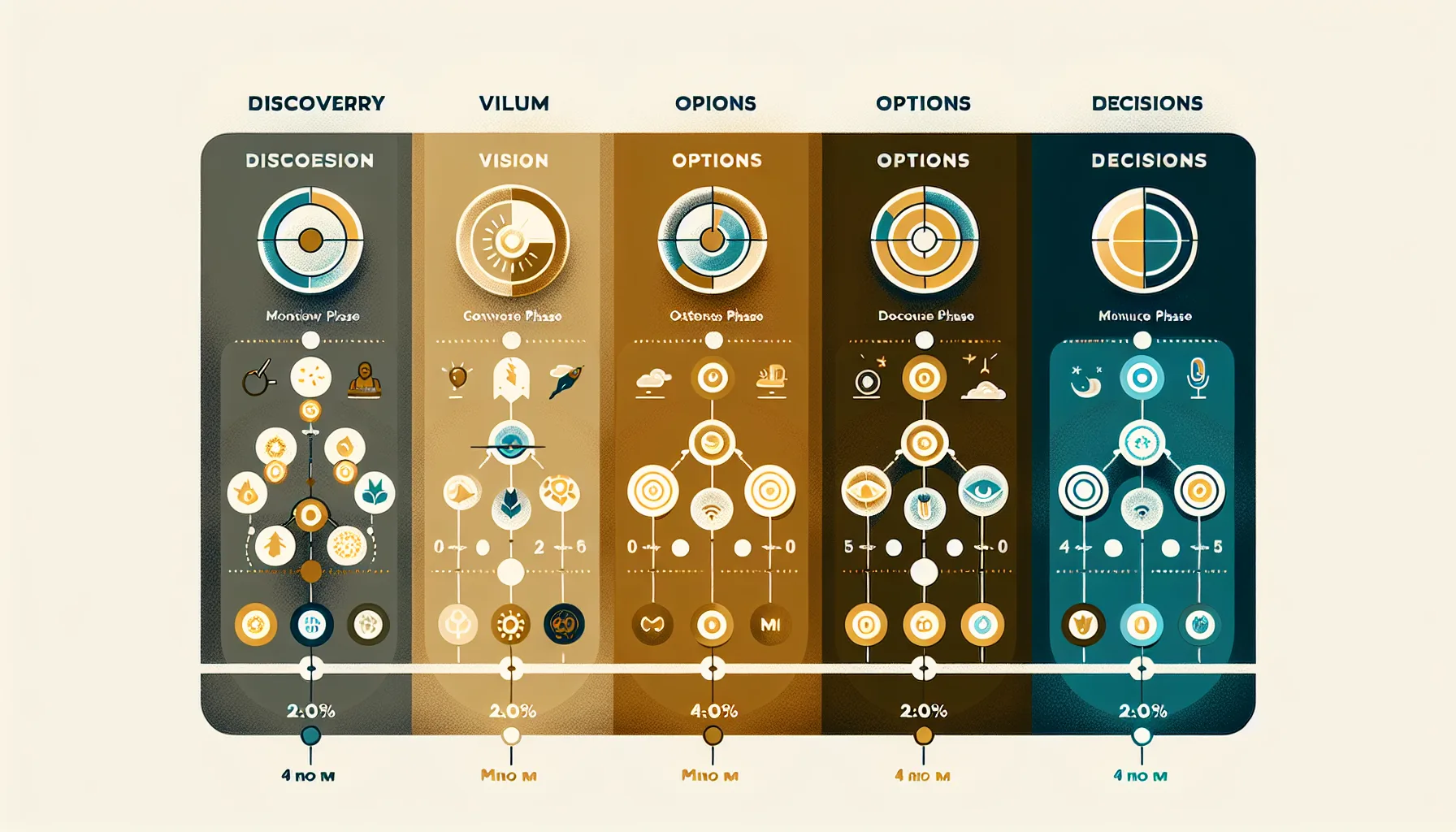
Phase 1: Discovery (15–20 Minutes)
Start by asking about the person, not the plans.
“Before we talk about anything else, I want to understand who [name] was. Tell me about him — what did he love? What was he known for? What would people say about him?”
This isn’t soft opening. It’s raw material. Every personalization element — the music, the photos, the reception details, the memorial keepsakes — comes from what families tell you in this phase. Families who spend 20 minutes describing a loved one are emotionally primed to choose services that honor what they’ve just described.
Specific questions that yield usable personalization material:
- What did they do for work? What were they proud of?
- What hobbies, passions, or obsessions defined them?
- What would you want people who couldn’t be there to know about them?
- What does your family need from this process — comfort, celebration, closure?
Take notes. Reference them explicitly in Phase 2.
Phase 2: Vision (10–15 Minutes)
Present a narrative before you present a price.
“Based on what you’ve told me about Margaret — that she was the center of every family gathering, that music was her whole life, that you want her grandchildren to have something they’ll remember — I’d like to show you what families in similar situations have created.”
This is where consumer behavior trends become operationally useful. The NFDA 2025 Consumer Study documents that families increasingly want personalized, meaningful experiences — not standardized service packages. When you present a vision that reflects the specific person the family described, you’re meeting that expectation before they’ve even formed the question.
Show examples: past photo tributes, ceremony setups, reception themes, keepsake items. Visual examples of what’s possible change what families request. The Parting Pro platform and Tribute Technology’s arrangement conference solutions both include libraries of past service examples that directors can use in this phase.
Phase 3: Options (15–20 Minutes)
Present three tiers, visually. Never verbally.
Research across service industries consistently shows that three-tier option presentation — good/better/best — drives higher average revenue without aggressive selling. Families anchor to the middle option when it’s positioned as the recommended choice. The key is that the middle option must actually be the right option for most families, not just the one you want to sell.
Tier 1: Essential
- Direct cremation or immediate burial
- Minimal ceremony, minimal coordination
- Serves families who genuinely want simplicity — and presenting this option with transparency builds trust
Tier 2: Celebration (Recommended)
- Cremation or burial with personalized ceremony
- Memorial tribute, reception coordination, professional arrangement
- Position with “most families who want what you’ve described choose something like this”
- This is where the revenue opportunity lives — and where families report the highest satisfaction
Tier 3: Legacy
- Full traditional service with comprehensive personalization
- Premium merchandise, extended ceremony, full catering coordination
- Present this as the complete option for families who want to go further
The Parting Pro digital presentation platform reports 20–30% revenue lifts in arrangement conferences that switch from printed GPL to visual digital presentation. The psychology is straightforward: families making decisions from a price list anchor on the number. Families making decisions from a visual presentation anchor on the experience. See the detailed breakdown in arrangement conference structural redesign.
Phase 4: Decisions (10–15 Minutes)
Walk through pricing transparently and without apology.
Families who understand what they’re paying for spend more — and feel better about spending it. Transparent pricing walkthrough means explaining the purpose of each line item, not just the cost. “The memorial tribute video is $450. That’s what gives you and your family a professional-quality recording of the service that you’ll have forever — and it means family members who can’t travel can watch it live.”
The GPL pricing strategy guide covers how to structure your price list to support this kind of value-forward communication. The key principle: families aren’t price-sensitive. They’re value-sensitive. When the value is clear, the price is acceptable.
Confirm all decisions in writing before the family leaves. This isn’t just compliance — it’s a final opportunity to review and adjust if the family wants to add anything they’ve reconsidered.
4. Visual Presentation: Why What Families See Changes What They Choose
The single highest-leverage tactical change you can make to an arrangement conference costs under $5,000 and takes one week to implement: replace the printed GPL with a digital visual presentation.

The Psychology of Verbal vs. Visual
When a funeral director reads a line item — “casket spray, $350” — the family processes it as a cost. When a funeral director shows a photo of a casket spray alongside a $350 price tag, the family processes it as a choice about how the service will look and feel.
That’s not a marketing trick. It’s how human decision-making works. We evaluate options differently when we can see them.
What Visual Presentation Changes
- Merchandise revenue increases because families can see what they’re buying before they commit. Seeing a quality urn next to a basic urn — with photos, materials descriptions, and price — produces very different decisions than hearing “urns range from $150 to $800.”
- Service upgrades increase because families can see what a celebration of life looks like versus a graveside service. Most families who “just want something simple” have never seen what a well-executed simple service looks like. Many of them would choose something more if they could see it.
- Direct cremation rates decrease — not because families are being upsold, but because families realize cremation and meaningful ceremony are not mutually exclusive. This is a critical insight from JCG 2026: the high direct cremation rate at many independent funeral homes reflects a failure of communication, not a preference for simplicity.
Platform Options
- Parting Pro: Purpose-built for funeral arrangement conferences. Includes product catalog integration, price presentation, e-signature, and reporting. Best-in-class for revenue tracking by director.
- Tribute Technology: Broader funeral technology suite that includes arrangement conference tools alongside website, tribute pages, and aftercare. Good for operators who want one integrated platform.
- Custom slide deck: A lower-cost starting point. Not as dynamic as dedicated platforms but far more effective than a printed GPL. Build one in PowerPoint or Keynote with service tier photos, merchandise photos, and pricing. Takes 2–3 days to build. Effective immediately.
If you’re acquiring a funeral home and want a quick win before your first full-process redesign, building a custom visual presentation deck is the highest-ROI first step.
5. The Personalization Premium: Why Cremation Services Can Outscore Burial
The conventional assumption in funeral home valuation is that a high cremation rate is a financial liability. That assumption is outdated.
Johnson Consulting Group’s 2026 data shows that cremation with memorial services scores NPS 90.2 versus traditional burial at 87.3. Well-executed cremation services deliver higher perceived value than traditional burial — because they offer more personalization flexibility, not less.
Why Cremation Allows More Personalization
Traditional burial carries structural constraints: timing, cemetery coordination, burial vault requirements, casket selection within cemetery approvals. Cremation is more flexible.
- Service timing can be weeks or months after death, allowing family to gather from across the country
- Location can be anywhere: a home, a restaurant, a park, a beach, a community center
- Ceremony structure is entirely up to the family — no standard liturgical format required
- Memorialization can be ongoing: scatter ceremonies, memorial plantings, keepsake jewelry, portion urns for multiple family members
Each of these personalization elements represents revenue. A family that wants a beach scatter ceremony, a custom photo tribute video, and portion urns for three siblings is spending $6,000–$9,000 on a cremation case. That’s not unusual. It’s increasingly the norm when the arrangement conference gives families the information to imagine it.
Specific Personalization Elements to Present
- Photo and video tributes: Memorial slideshow with music, professional-quality video recording of the service, livestreaming
- Custom urns and keepsakes: Handcrafted urns, memorial jewelry made from cremated remains, personalized keepsake boxes, seedling urns that grow into trees
- Reception coordination: Venue, catering, décor that reflects the deceased’s personality — a fisherman’s reception, a jazz theme, a family recipe potluck
- Scatter ceremonies: Officiated ceremonies at meaningful locations, custom scatter vessels
- Portion urns: Multiple urns for family members who want to keep a portion of remains — a meaningful upsell that serves a genuine family need
The revenue from a single well-executed cremation celebration-of-life can exceed many traditional burial cases. Model this in your acquisition projections.
6. Post-Conference Follow-Up That Reinforces Value
The arrangement conference doesn’t end when the family walks out. What happens next determines whether they write a five-star review, refer their friends, or become preneed customers — or whether they quietly feel the experience didn’t meet expectations.
The Follow-Up Timeline
Same day — Confirmation email
Send a written summary of all arrangements made, with pricing, contact information, and what happens next. This isn’t a receipt. It’s a reassurance that everything is handled. Include a personal note referencing something specific the family shared in the conference.
48 hours — Pre-service check-in
A brief call or message to confirm everything is on track and ask if the family has any questions before the service. This is also the appropriate moment to offer any additions they may have considered since the conference — not as a sales call, but as a service checkpoint.
Two weeks post-service — First aftercare contact
A card, a call, or a personal message acknowledging that two weeks out is often when the reality of loss settles in most heavily. No sales agenda. Grief support resource referral if appropriate. This builds the relationship that makes the 3-month and 12-month contacts feel natural, not commercial.
Three months post-service — Second aftercare contact
Check in on how the family is doing. This is also the appropriate time to mention preneed planning — not aggressively, but as a natural extension of caring for the family. “Many families who’ve been through this process find it gives them peace of mind to have their own arrangements in place. We’d be happy to have that conversation whenever you’re ready.”
Review solicitation timing
Request reviews at the two-week post-service contact, not immediately after the service. Families are better positioned to reflect and articulate their experience after some time has passed. A direct, personal ask — “It would mean a great deal to us if you’d share your experience” — converts at higher rates than a generic automated email.
Full aftercare program structure is covered in the grief support and aftercare programs guide.
7. Measuring What Matters: The Conference Performance Dashboard
You cannot manage what you don’t measure. Most acquired funeral homes have no systematic conference performance tracking. Building a measurement infrastructure from day one gives you a baseline, reveals improvement opportunities, and creates a data asset that increases your business’s value at exit.
The Core Metrics
Revenue per call by director
This is your most important metric. Individual variation in revenue per call reveals where process and communication improvements will have the highest impact. A director averaging $3,200/call on cremation cases while another averages $6,800 on the same service type isn’t a talent difference — it’s a training and process difference.
Revenue per call by service type and approach
Track cremation-with-service separately from direct cremation and traditional burial. Monitor the trend monthly. As your conference process improves, you should see cremation-with-service revenue increase and direct cremation rate decrease — not because you’re pushing families away from direct cremation, but because more families are learning that cremation with a service is possible and choosing it.
Service type mix trends
What percentage of cremation families are choosing a service versus direct disposition? How is this trending quarter-over-quarter? This is the clearest signal of whether your conference process is working.
Family satisfaction surveys
Implement a simple NPS-format post-service survey. Track overall satisfaction, perceived value (specifically: “Do you feel the service reflected the person you lost?”), and likelihood to recommend. Perceived value scores are the leading indicator of referral behavior and preneed conversion.
A/B Testing Your Conference Process
Once you have six months of baseline data, you can begin structured testing. Introduce one process change — a new visual presentation format, a different discovery question sequence, a modified three-tier structure — and track its effect on revenue per call and satisfaction scores over the next quarter. This turns your arrangement conference into an iterative improvement system rather than a fixed process.
Quarterly Conference Review
Schedule a quarterly review with your funeral directors. Bring the data: revenue per call by director, service mix trends, satisfaction scores. Review three to five recorded conferences (with consent) to identify patterns and coaching opportunities. This isn’t performance management — it’s professional development. Directors who see data tend to engage with improvement more readily than directors who receive only subjective feedback.
Modeling Conference Improvements in Your Acquisition ROI
If you’re still in the evaluation phase, conference performance data from the target funeral home is a critical input to your acquisition model. A 15% improvement in revenue per call — which is a realistic and achievable target in the first 12–24 months post-acquisition at a conference-deficient funeral home — on a 150-call operation at a current $5,000 average produces $112,500 in additional annual revenue. At a 3x SDE multiple, that’s $337,500 in enterprise value creation from a process improvement.
Resources like Lendesca can help you model how revenue-per-call improvements affect your acquisition ROI projections — useful for stress-testing your pro forma before you go under letter of intent.
Frequently Asked Questions
What is the most important change a new funeral home owner can make to the arrangement conference?
Switching from a printed General Price List to a visual digital presentation platform — such as Parting Pro or Tribute Technology — is the highest-ROI single change. Johnson Consulting Group data and operator reports both point to 20–30% revenue lifts from this change alone.
How do I know if a funeral home I’m evaluating has a poor arrangement conference process?
Request revenue per call by service type and by funeral director. High direct cremation rate, below-market average revenue per call, and no visual presentation tools are the three clearest signals. Sitting in on a conference during due diligence will confirm or complicate what the numbers suggest.
Can cremation revenue match or exceed traditional burial revenue?
Yes. JCG 2026 data shows cremation with memorial services scoring higher NPS than traditional burial. A cremation case with personalized ceremony, reception coordination, photo tribute, and keepsake merchandise regularly reaches $7,000–$10,000+. The ceiling on cremation revenue is primarily set by conference quality, not market preference.
When should I solicit reviews from families?
Two weeks post-service is the optimal timing for review solicitation. Families have had time to process the experience, are better able to articulate what they valued, and are past the immediate acute grief that can make a review request feel intrusive.
How long does it take to see revenue improvement from conference redesign?
Most operators see measurable improvement in average revenue per call within 90 days of implementing visual presentation tools and structured discovery. Full cultural adoption of a value-first conversation framework typically takes 6–12 months, with revenue per call continuing to improve as director confidence builds.
What This Means for Your Acquisition Thesis
When you evaluate a funeral home’s revenue per call, the right question is: is this a ceiling or a floor?
At most independent funeral homes — particularly those that have operated under the same ownership for 15–20 years — current revenue per call is a floor. The market isn’t the constraint. The conference process is.
A 15–20% revenue per call improvement post-acquisition is achievable without raising prices, without adding calls, and without expanding your service area. It requires process redesign, visual presentation tools, director training, and systematic measurement. All of it is within your control.
That’s the kind of operational leverage that justifies paying a fair multiple for a well-positioned funeral home. Build the conference redesign into your post-acquisition plan. Implement measurement from day one. Use the data to coach your team and refine your process over the first 12–24 months.
The families who sit across from your funeral director in that room deserve the best conversation of their worst week. Give them that — and the revenue follows.
Related reading: Arrangement Conference Structural Redesign | GPL Pricing Strategy for New Owners | The Perceived Value Gap in Due Diligence | Consumer Behavior Trends: Buyer Intelligence | Grief Support and Aftercare Programs