
You did the due diligence. You negotiated the price. You signed, wired the funds, and the funeral home is yours. Congratulations. Now comes the part nobody prepared you for.
The phone has to ring.
Every acquisition model you built assumed a baseline case volume. That number came from the seller’s trailing twelve months. It looked stable. What nobody told you is that case volume is not a fixed asset you purchased. It depends on relationships, reputation, and community awareness — all of which are in flux the moment ownership changes hands.
Your first year will go one of three directions: volume holds steady, volume grows, or volume begins a slow, quiet decline that doesn’t show up clearly until month eight when it’s much harder to reverse.
This is the operational playbook for making sure it goes in the right direction. Not the digital marketing playbook — that’s covered elsewhere. This is the revenue growth plan that happens in the community, in referral offices, at church halls, and at the arrangement table.
Why Case Volume Drops After Ownership Transitions (And How to Prevent It)
Before you build a growth plan, you need to understand why volume drops in the first place. Most new owners assume the brand transfers. It doesn’t. Not automatically.
Community trust is personal
Families did not choose “Greenfield Funeral Home.” They chose Mike Greenfield. They chose the man who sat with their mother at their father’s service eleven years ago. They chose the person their pastor recommended by first name. When Mike sells and disappears, the trust equation resets to zero.
This is not a branding problem. It is a relationship vacancy.
Staff departures amplify the damage
When a funeral home changes hands, staff get nervous. If your lead funeral director leaves in month two, two things happen simultaneously: you lose someone who knows 200+ families by name, and the community reads the departure as a signal that something is wrong.
The funeral industry is facing an acute workforce shortage — roughly 5,700 funeral director openings per year against approximately 1,600 mortuary school graduates. You cannot replace experienced directors quickly, and you cannot replace their relationships at all.
Competitors are paying attention
Every competitor in your market noticed the ownership change. Some will be subtle about it — mentioning to hospice contacts that “things are in transition over at Greenfield.” Others will be direct, running targeted ads or increasing community presence in your service area.
This is standard competitive behavior in a market where one funeral home’s transition means 150–300 cases are suddenly up for grabs.
The visibility gap
For the first six months, you are functionally invisible. Referral sources are cautious. Families default to the competitor they’ve heard of. You are operating on the previous owner’s momentum, and that momentum has a half-life.
Prevention starts before day one
The single most effective thing you can do is keep the previous owner visible for 6–12 months through a consulting agreement. They attend community events. They introduce you to key contacts. They show up at the funeral home periodically so families see continuity, not abandonment.
Pair this with staff retention (retention bonuses, title upgrades, job security conversations on day one) and transparent communication — a local paper announcement, a letter to preneed contract holders, a website mention. All of it signals stability.
The metric that tells you whether prevention is working: compare your at-need call volume in months 1–6 against the trailing twelve-month average at the time of close. If you’re within 5%, you’ve managed the transition well. If volume drops 10% or more in the first six months, you have an active problem — not a seasonal dip — and you need to accelerate every strategy in this playbook.
Building Referral Relationships That Drive At-Need Volume
Funeral homes generate most cases through a small ecosystem of institutional referral sources — organizations that interact with people at or near end of life and direct families toward a specific provider.
These relationships are the single most important revenue driver in death care. And every one of them belonged to the previous owner.
The referral ecosystem
Your primary referral sources, roughly in order of case volume impact:
- Hospice programs. The most valuable single referral source for most funeral homes. Hospice staff are present at the moment of death and are often asked directly: “Who should we call?” Their answer drives cases.
- Hospitals. Discharge planners, social workers, and chaplains direct families to funeral homes, particularly for at-need deaths in hospital settings.
- Nursing homes and assisted living communities. Residents who pass in these facilities generate direct referrals, often based on long-standing relationships between the facility and the funeral home.
- Clergy. Pastors, priests, rabbis, and imams are frequently the first call a family makes. Their recommendation carries enormous weight.
- Veterans organizations. VFW posts, American Legion chapters, and veteran service officers refer families of deceased veterans, particularly for services involving military honors.
- Medical examiner and coroner’s office. For cases involving unattended deaths, accidents, or investigations, the ME/coroner’s office directs family contact and body release.
- Estate planning attorneys and elder law firms. They interact with clients actively planning for end of life and can recommend preneed arrangements.
How to rebuild the referral network
Step 1: Identify every referral source in the first 30 days. Ask your staff. Review call records and first-call logs for the past two years. Build a spreadsheet: organization name, key contact, estimated annual case volume, date of last contact.
Step 2: Introduce yourself in person. Not by email. Not by phone. In person. Your script: “I’m the new owner of Greenfield Funeral Home. I wanted to introduce myself, understand how we’ve been serving your families, and ask if there’s anything we could do better.” Then listen. Follow up within 48 hours with a handwritten thank-you note. This sounds old-fashioned. It works because your competitors are sending emails.
Step 3: Provide value before you ask for anything. Host a lunch-and-learn at their facility on advance care planning. Provide printed grief resource guides. Partner on a community education event. You are building a relationship, not running a referral program. The referrals follow the relationship.
The hospice relationship deserves its own strategy
Hospice is often responsible for 25–40% of a funeral home’s at-need cases. Hospice patients have a median length of stay of approximately 18 days (NHPCO data), which means the hospice team is present during the family’s most vulnerable window — and their recommendation is frequently accepted without question.
- Meet the hospice medical director, nursing supervisors, and social workers individually.
- Offer bereavement support resources — grief packets, memorial keepsake materials, counseling referrals.
- Volunteer to speak at hospice staff in-service training on body donation coordination, religious customs, or the funeral planning process.
- Respond immediately to every hospice first call. Speed and compassion are the two things hospice staff evaluate most.
Timeline reality check: Expect 3–6 months before new referral relationships begin producing consistent case volume. These are human relationships built on trust, and trust takes time. Do not expect instant results, but do expect compounding returns.
Preneed Marketing: The Long Game That Pays for Everything
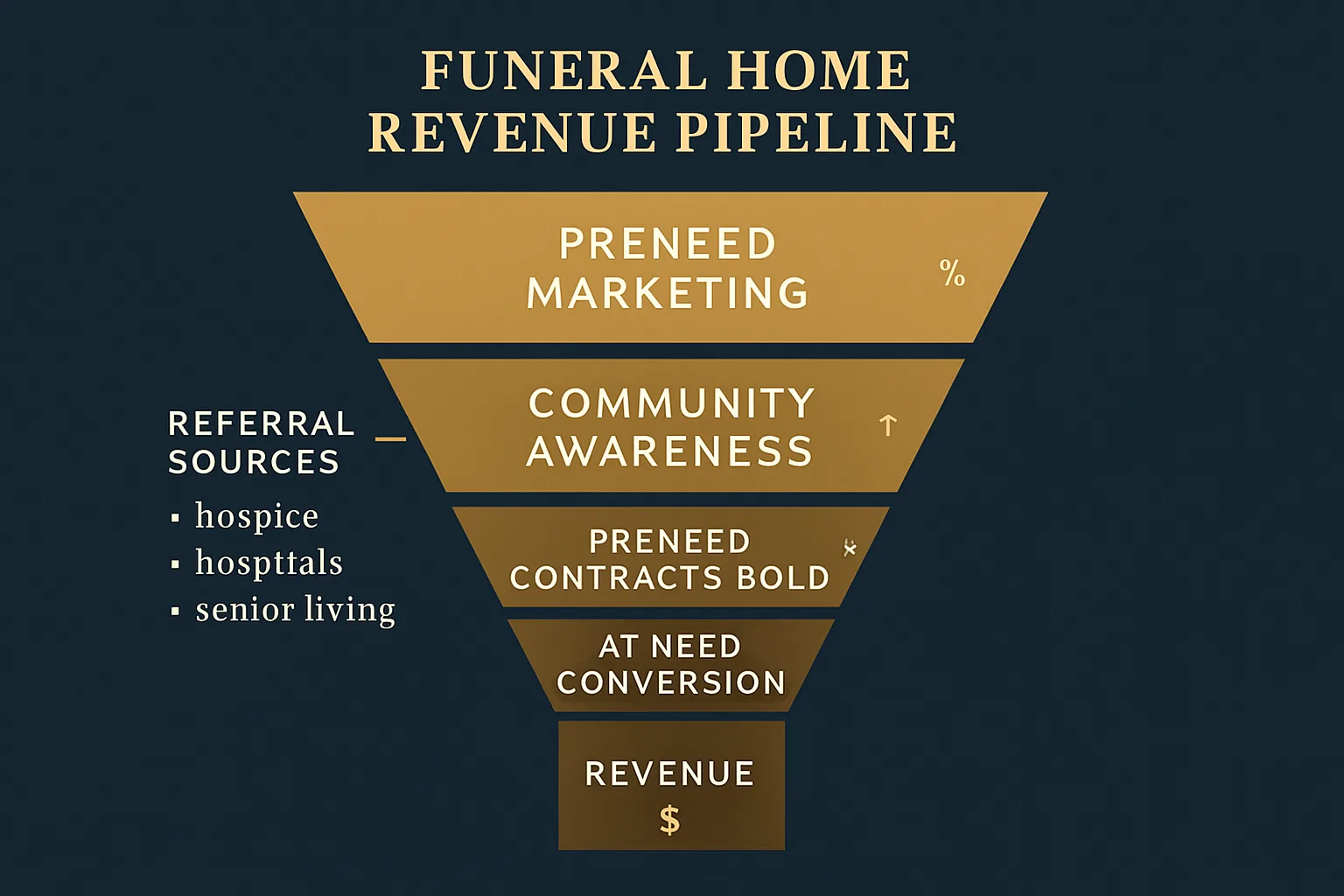
If referral relationships drive your at-need volume today, preneed marketing drives your at-need volume three to seven years from now.
What preneed means for revenue growth
A preneed contract is a legally binding agreement in which a living person purchases funeral services at today’s prices, to be fulfilled at their death. (For a deep dive on preneed contract structures, funding mechanisms, and due diligence, see our separate guide on preneed contracts.)
Here is why preneed matters for your revenue growth strategy: every preneed contract sold is a locked-in future at-need call.
The conversion rate is remarkable. Industry data consistently shows that 85–90% of families who prearranged with a specific funeral home will use that funeral home at the time of need. Compare that to the at-need market, where families are choosing in real time among every competitor in the area. Preneed removes the competition entirely.
A strong preneed program generates immediate revenue (commissions and trust deposits), locks in future at-need cases (each contract is a family that will call you, not your competitor), and builds community relationships by putting you in front of living, healthy people who will remember your name.
Preneed marketing channels that actually work
Community seminars. Free educational sessions at senior centers, churches, and assisted living facilities. Title them approachably: “Planning Ahead: What Your Family Needs to Know.” These are educational events that naturally lead to prearrangement conversations. Expect 15–30 attendees per seminar, with 3–5 preneed appointments booked from each.
Direct mail campaigns. Targeted mailers to households with residents aged 60+ in your service area. Simple, informational, with a clear call to action — a free planning guide or seminar invitation. Response rates run 0.5–1.5%, which sounds low until you calculate the lifetime value of each preneed contract.
Digital campaigns. Facebook and Google ads targeting pre-planning keywords (“plan funeral in advance,” “funeral preplanning near me”) and demographic segments (55+, estate planning interests). Digital preneed marketing is underutilized in most local markets, which means lower cost per lead. Budget $500–$1,500/month for a meaningful test.
Professional partnerships. Estate planning attorneys, financial advisors, and elder law firms interact with clients actively organizing their affairs. Offer referral resources, educational materials, or joint seminars on “Getting Your Affairs in Order.”
Preneed insurance provider co-marketing. Companies like Homesteaders Life Company and NGL (National Guardian Life) offer co-marketing programs, lead generation support, and sales training for partner funeral homes. If you’re insurance-funded, your preneed provider likely has a marketing program you’re not using. Call your regional rep.
The preneed investment math
For a single-location funeral home, budget $15,000–$25,000 per year. What that produces:
- $20,000/year in spend (seminars, direct mail, digital, materials)
- 40–60 preneed contracts written at $6,000–$8,000 average contract value
- $240,000–$480,000 in preneed contract value written annually
- Conversion to at-need calls over 3–7 years
Preneed is a pipeline business. You’re spending $20,000 today to lock in $240,000–$480,000 in future revenue your competitors cannot take from you.
When to start
Not month one. You have enough to manage in the transition. Start preneed marketing in months 3–4, after you have stabilized operations, retained your staff, met your referral sources, and established a basic community presence. Trying to sell preneed before the community knows and trusts you is a waste of money.
Community Outreach: Becoming the Funeral Home People Think of First
Death care is a top-of-mind awareness business. When a death occurs, the family typically makes a funeral home decision within two to four hours. They are not researching. They are not comparison shopping. They are calling the name that comes to mind first.
Your job in the first year is to become that name.
Outreach strategies that build awareness without feeling like marketing
Grief support groups. A free, monthly group open to anyone — not just families who used your funeral home. Facilitate it yourself or bring in a licensed grief counselor. These build deep goodwill, generate word-of-mouth referrals, and position your funeral home as a place of ongoing care. Typical attendance: 8–15 people per session, growing over time.
Veterans’ events. Partner with local VFW and American Legion posts for Memorial Day and Veterans Day ceremonies. Offer your facility as a venue. Provide printed programs. Veterans’ organizations are deeply connected communities with strong referral behavior.
Holiday remembrance events. Annual candle-lighting ceremonies, tree-of-remembrance events, or butterfly releases. These serve a genuine need — families want structured opportunities to remember — and they bring 50–200 community members to your facility.
Local sponsorships. Youth sports teams, school programs, community theater, charity 5Ks. Small sponsorships ($250–$1,000) put your name on jerseys, programs, and banners. Not about direct lead generation — about name recognition and goodwill.
Pet loss support. This surprises new owners. A free pet loss resource — even a webpage and a pamphlet at veterinary offices — builds awareness among pet owners who will eventually need human funeral services and will remember the funeral home that treated their grief with respect.
Educational partnerships. Speak at Rotary clubs, Kiwanis meetings, church groups, and senior center programs on advance directives, funeral planning, or funeral traditions. Low-cost, high-visibility opportunities to position yourself as an expert and community member.
The consistency principle
One community event per year is a gesture. One per month is a strategy. The funeral homes that dominate their markets in community awareness are the ones that show up consistently — not with the biggest budget, but with the most reliable presence.
Build a twelve-month outreach calendar before the end of your first quarter. Assign staff to each event. Budget $500–$1,500 per month for expenses. Hold yourself accountable to the calendar the same way you hold yourself accountable to financial targets.
Your staff are your brand ambassadors
Every staff member who interacts with the community represents your funeral home. The funeral director who coaches Little League, the office manager who volunteers at the food bank — these connections generate cases.
Pay for professional memberships. Give staff time for community events during work hours. Recognize and reward community involvement. This is not charity. It is business development executed through human connection.
Improving At-Need Capture Rate: Getting the Calls You Should Already Be Getting
Before you spend money on growth, make sure you’re not leaking cases you should already be getting.
Understanding capture rate
Capture rate is the percentage of deaths in your service area that your funeral home handles. Calculate it by dividing your annual at-need case count by total deaths in your county (available from the CDC’s WONDER database or your state vital records office; the national death rate is approximately 10.4 per 1,000 population).
A well-run independent in a market with three to five competitors typically captures 15–25% of deaths in its primary service area. Below 15% means room to grow without taking market share — you just need to stop losing cases you should be getting.
Low-hanging improvements that increase capture rate
Answer the phone 24/7.
This sounds obvious. It is the single most common failure point.
When a death occurs at 2:00 AM, the family calls the funeral home. If they get a voicemail, they hang up and call the next name on the list. That family is gone. You will never know they called.
Use a professional answering service. ASD (Answering Service for Directors) is the industry standard, handling over 20,000 calls per month for funeral homes. Cost: $200–$400/month. Return: every 2:00 AM call you would have otherwise lost.
Optimize your Google Business Profile.
When a death occurs, most families search “funeral home near me” on their phone before calling anyone. Your Google Business Profile (GBP) is what appears. If your hours are wrong, your photos are outdated, or you have three reviews from 2019, they scroll past.
- Verify and claim your GBP listing on day one
- Upload 15–20 current, professional photos
- Ensure hours, phone number, and address are accurate
- Respond to every review within 48 hours
- Ask satisfied families to leave reviews (a simple card after the service works)
Fix your website.
Your website needs to do one thing at 2:00 AM: make it easy for a grieving family to call you. Phone number visible without scrolling, on every page, large enough to tap on a phone screen. If it was built by the previous owner’s nephew in 2016, replacing it is a first-quarter priority.
Reduce first-call response time.
How quickly can you arrive at the place of death? In a competitive market, 30 minutes beats 90 minutes every time. Staff your on-call rotation to ensure response within 45 minutes across your entire service area.
Track the numbers monthly
Build a simple monthly dashboard:
- Calls received (total inbound calls, including after-hours)
- Arrangements made (cases that converted from call to arrangement conference)
- Call-to-arrangement conversion rate (should be 85%+ for at-need calls)
- Average revenue per case (total at-need revenue divided by cases served)
If your call-to-arrangement conversion rate is below 80%, you are losing families between the first call and the arrangement conference. That is a staff training issue, a responsiveness issue, or a pricing issue — and it’s worth diagnosing immediately.
The Organic Growth vs. Acquisition Growth Decision
Sometime toward the end of year one — assuming you’ve stabilized volume and started to grow — you’ll face a strategic question: do you keep growing this location organically, or do you start looking for a second acquisition?
The case for organic growth
Organic growth means increasing case volume at your existing location through the strategies in this playbook: better referral relationships, preneed marketing, community outreach, improved capture rate.
- Lower capital requirement. You’re spending $20,000–$50,000 per year on marketing and outreach, not $500,000–$2,000,000 on another acquisition.
- Lower operational complexity. One location. One team. One set of compliance requirements.
- Compounding returns. Preneed contracts sold this year become at-need calls for years to come. Referral relationships deepen over time. Community awareness builds on itself.
The case for acquisition growth
Acquisition growth means buying a second funeral home — usually within a 30–60 minute drive of your first location — to increase total case volume through market expansion.
- Faster top-line growth. You’re buying an existing case volume stream, not building one from scratch.
- Geographic coverage. A second location expands your service area and captures families who wouldn’t drive to your first location.
- Operational efficiencies. Two locations can share back-office functions, embalming facilities, and rolling stock.
The math that most people get wrong
Here’s the comparison most new owners don’t run:
Scenario A — Organic: 200 cases/year at $6,500 average revenue ($1.3M). Grow 5% organically = 10 additional cases = $65,000 incremental revenue. At 40% EBITDA margin, that’s $26,000 in additional profit on $25,000–$40,000 in marketing spend.
Scenario B — Acquisition: Buy a second location doing 120 cases/year for $900,000. After SBA debt service ($90,000–$110,000/year), management overhead, and transition costs, year-one incremental EBITDA: $30,000–$50,000 — with far more risk and capital deployed.
Organic growth often produces a comparable or better return on invested capital, with far less risk, in years one through three.
When acquisition makes sense
Acquisition becomes the right move when:
- Your facility is at physical capacity. If your chapel, arrangement rooms, or prep room are booked to the point where you’re turning away cases or degrading service quality, you need more space — and buying is often cheaper than building.
- A nearby competitor becomes available. If a funeral home in your market comes up for sale and a consolidator might buy it, acquiring it defensively can protect your market share.
- You’ve built strong operational systems that can replicate at a second location without degrading service at the first.
Most industry advisors recommend two to three years of organic growth before pursuing a second acquisition. That gives you time to learn the business, build your reputation, and develop infrastructure for multi-location management.
Measuring What Matters: Your First-Year Revenue Dashboard
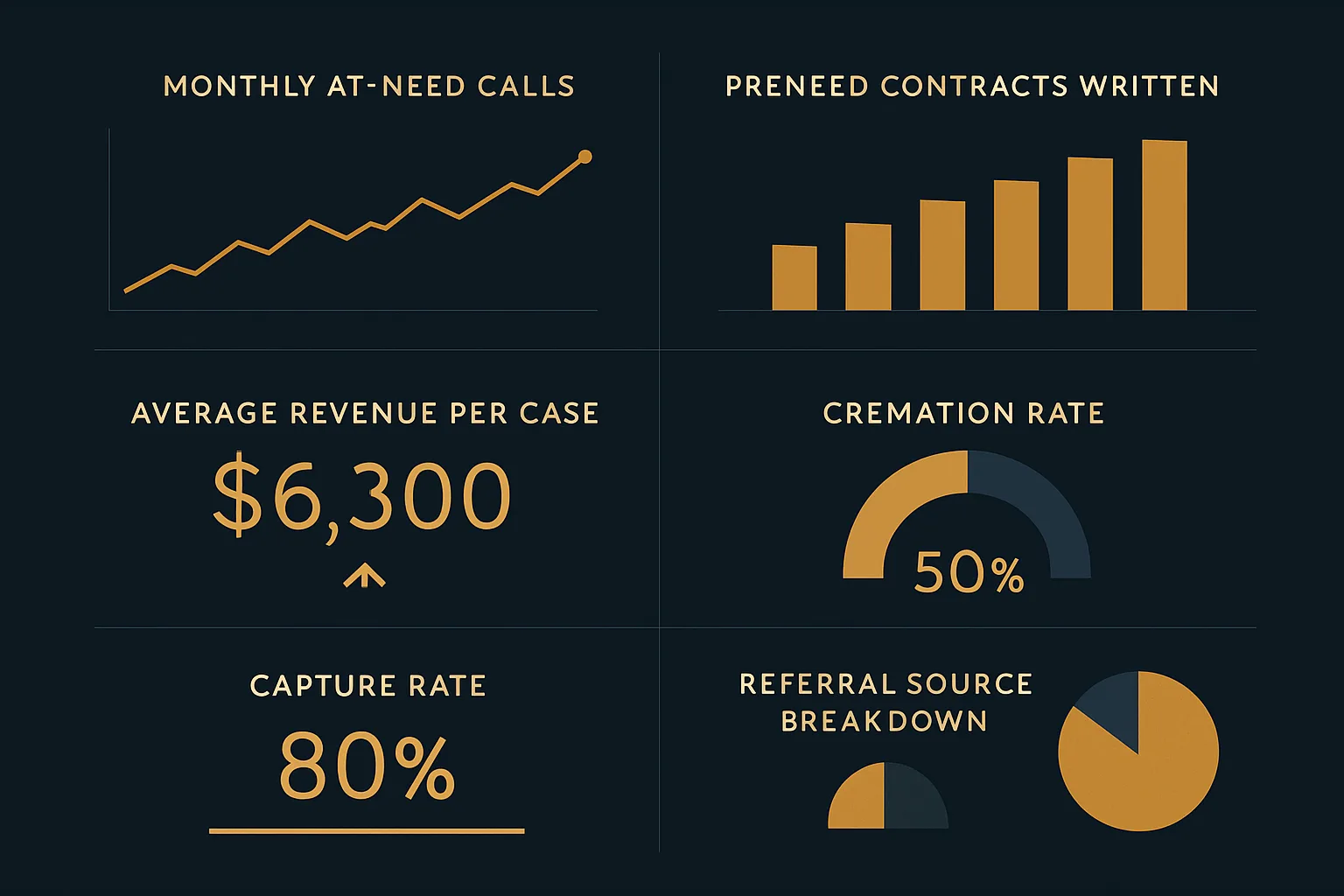
You cannot manage what you do not measure. Build this dashboard in your first month and review it weekly.
Monthly metrics to track
| Metric | What It Tells You | Target |
|---|---|---|
| At-need call volume | Are families calling you? | Maintain or exceed trailing 12-month average |
| Call source tracking | Where are cases coming from? | Growing share from referral and preneed sources |
| Preneed contracts written | Are you building future pipeline? | 3–5 contracts/month by end of year one |
| Average revenue per case | Are you maintaining pricing integrity? | Flat or growing vs. prior year |
| Cremation rate | What’s the service mix trend? | Track direction; national average is ~60% |
| Cremation with services rate | Are cremation families choosing ceremonies? | Growing (revenue protection lives here) |
| Referral source volume | Which partners are sending families? | At least 3 consistent referral sources |
| Google reviews | How is your online reputation? | 4.5+ stars, growing review count monthly |
| Customer satisfaction | Are served families happy? | Follow-up survey to every family, 30 days post-service |
How to read the dashboard
Months 1–3: Stabilization mode. Match the trailing twelve-month averages, not exceed them. Holding steady means the transition is working.
Months 4–6: Preneed marketing starts. Referral relationships form. You should see early indicators — more hospice calls, a few preneed appointments from your first seminar — even if the numbers haven’t moved significantly.
Months 7–12: Compounding begins. Referral sources produce consistent cases. Preneed contracts accumulate. Community awareness translates into calls from families you’ve never served. If at-need volume is 5–10% above the trailing twelve-month average by month twelve, you’re executing well.
The number that matters most: at-need case volume. Everything else is a leading indicator or diagnostic. Cases pay the bills.
Frequently Asked Questions
How long does it take for case volume to stabilize after a funeral home changes ownership?
In a well-managed transition — where the previous owner stays visible, key staff are retained, and referral sources are contacted within the first week — volume typically stabilizes within three to six months. A poorly managed transition can produce volume declines that take twelve to eighteen months to recover.
The critical variable is staff retention. If your lead funeral director stays and the community sees continuity, stabilization happens faster. If key staff depart, you’re rebuilding from a much lower baseline.
What’s a reasonable preneed marketing budget for a single-location funeral home?
$15,000–$25,000 per year for a location handling 150–250 cases annually. This covers monthly seminar expenses ($300–$500 per event), quarterly direct mail campaigns ($2,000–$4,000 per mailing), digital advertising ($500–$1,500/month), and printed materials.
Scale with case volume: 100 cases/year warrants $10,000–$15,000; 400+ cases warrants $30,000–$40,000. The return timeline is long — three to seven years for preneed to convert to at-need — so treat it as a capital investment, not a discretionary expense.
Should I lower prices to attract more families in my first year?
Almost certainly not. Price cutting is a race to the bottom that erodes revenue per case and market positioning. Families choose on trust, reputation, and recommendation — not price.
If you’re losing families to a lower-priced competitor, the answer is more community visibility, stronger referral relationships, and service quality that justifies your pricing. Most families will pay a premium for a funeral home they trust.
The exception: if the previous owner’s pricing was significantly above market (20%+ higher than comparable competitors), a surgical correction on specific outlier items may be warranted. But never cut across the board.
What if I’m in a market with a dominant competitor?
You will not out-spend them. You can out-serve them. Focus on underserved segments: families the dominant competitor doesn’t prioritize — cremation with personalized ceremonies, specific cultural or religious communities, grief support resources nobody else offers. Find the gap in their service model and fill it consistently.
Build referral relationships they’ve neglected. Every market has hospice programs, clergy, and facilities that feel underserved by the dominant provider. Those are your entry points.
How do I track where my cases are coming from?
Train your staff to ask one question at intake: “How did you hear about us?” Record it in your case management software. Categories: prior relationship/repeat family, hospice referral, hospital referral, clergy referral, online search, drive-by/signage, preneed contract matured, and other. Review monthly. Most funeral homes discover that 60–70% of cases come from just two or three sources — and one of those sources is getting zero intentional investment.
This guide is part of the Funeral Home Buyer resource library — acquisition intelligence for serious buyers, from due diligence through operations.
Funeral Home Buyer provides educational content for professionals evaluating business acquisitions in the funeral services industry. This article is not legal, financial, or investment advice. Consult qualified professionals before making acquisition decisions.