
You can negotiate the perfect deal, secure ideal financing, and inherit a profitable operation. None of it matters if the FTC finds your funeral home out of compliance with the Funeral Rule. One undercover call. One missing price list. One staff member who bundles services they shouldn’t. That’s all it takes.
This guide breaks down exactly what the Funeral Rule requires, where new owners get caught, and how to build compliance into your operation from day one.
The One Federal Regulation You Cannot Get Wrong
The FTC Funeral Rule — formally 16 CFR Part 453 — is the single federal regulation that governs every funeral provider in the United States. No exceptions. No exemptions based on size, volume, or ownership structure.
The rule was enacted in 1984 and last substantively revised in 1994. Don’t let the age fool you. The FTC enforces it aggressively, and the penalties reflect three decades of inflation adjustments.
Current penalties exceed $50,000 per violation. That’s per violation, not per investigation. A single undercover sweep that finds three problems can generate $150,000 or more in fines before you’ve hired a lawyer.
How FTC enforcement actually works
The FTC doesn’t wait for consumer complaints. They run the Funeral Rule Offender Program (FROP), sending undercover investigators to funeral homes posing as bereaved families. These investigators call on the phone. They walk in the door. They ask for prices, ask about embalming, ask about caskets.
They’re testing whether your staff follows the rule. Every time.
Why ownership transitions are peak risk
When a funeral home changes hands, compliance gaps multiply. The previous owner’s price lists may be outdated. Staff may have learned informal practices that worked under the old regime but violate the rule. Training documentation may not exist. The compliance binder — if there ever was one — may have walked out the door with the seller.
The FTC doesn’t care that you just bought the place. You own it, you’re responsible. Period.
What the Funeral Rule Actually Requires
The Funeral Rule centers on four documents, a set of mandatory disclosures, and a telephone pricing obligation. Every requirement exists for the same reason: preventing funeral providers from exploiting grieving families through deception, bundling, or omission.
The four required documents
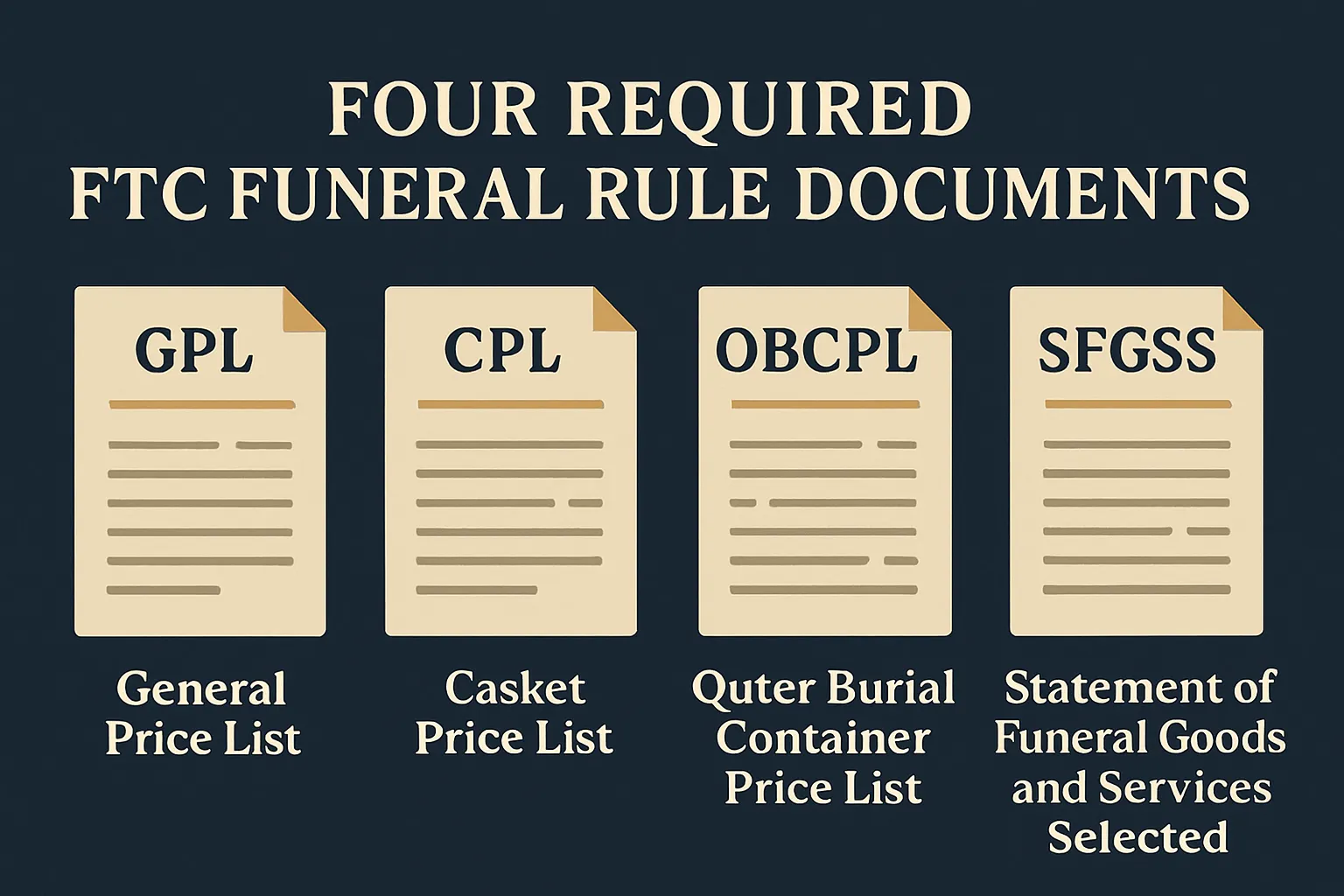
1. General Price List (GPL)
The GPL is the cornerstone document. It must list the prices for every service and merchandise item you offer, itemized individually. You must give a printed GPL to anyone who inquires about funeral arrangements, services, or prices — in person.
This isn’t optional. It’s not “upon request.” If someone walks in and asks about funeral services, they get a GPL. They keep it. You cannot ask for it back.
2. Casket Price List (CPL)
A separate printed list showing every casket you offer with its retail price. You must provide this to anyone who asks about caskets, before showing them any casket.
3. Outer Burial Container Price List (OBCPL)
Same concept as the CPL, but for outer burial containers — vaults and grave liners. Required before showing any container merchandise.
4. Statement of Funeral Goods and Services Selected (SFGSS)
This is the itemized statement given to the family at the end of the arrangement conference. It lists every item and service they selected, the price of each, and the total. It must also include all required disclosures.
The SFGSS is your paper trail. If an enforcement action occurs, this document either proves compliance or convicts you.
Required disclosures
The rule mandates specific language on your GPL and SFGSS. These aren’t suggestions — they’re word-for-word requirements:
- Embalming disclosure: You must state that embalming is not required by law, except in certain special cases. You must get explicit permission before embalming and may not tell families embalming is required when it isn’t.
- Alternative container disclosure: Families choosing direct cremation must be informed they can use an alternative container instead of a casket.
- Right to provide own casket: You must disclose that families can purchase a casket from a third party, and you cannot refuse to handle it, charge a fee for handling it, or require them to be present when it’s delivered.
- No preservation claims: You cannot represent that any funeral good or service will preserve the body indefinitely. This includes claims about “protective” or “sealer” caskets preserving remains.
Telephone price disclosure
When someone calls and asks about prices, you must provide prices over the phone. Not “come in and we’ll discuss it.” Not “it depends on what you choose.” You give them the prices they ask about, over the phone, immediately.
This is the most commonly violated provision of the entire rule. We’ll get to why in the next section.
No tying arrangements
You cannot condition the purchase of one item on the purchase of another. You cannot require a family to buy a casket if they want a viewing. You cannot require embalming for a particular type of service unless state or local law actually mandates it (and it rarely does).
Every service, every item, must be available individually. Bundled packages are fine — as long as individual pricing is also available and clearly presented.
The Most Common Violations (And How They Happen)
FTC enforcement data tells a consistent story. The same violations appear over and over, across funeral homes of every size and in every region. Understanding these patterns is critical, because you’re likely inheriting at least one of them.
Failure to provide prices over the phone
This is the single most common violation found during FTC sweeps. It happens because staff are trained — formally or informally — to get families into the building. “Every arrangement is different.” “We’d love to sit down with you.” “It really depends on your needs.”
All of those responses violate the rule.
When someone calls and asks “How much does a direct cremation cost?” — you give them a number. When they ask about your basic service fee, you give them a number. The rule is absolute on this point.
New owners inherit this problem because phone behavior is deeply ingrained in staff culture. The previous owner may have tolerated or even encouraged deflection. Your staff may not even realize they’re violating federal law.
Bundling services and misrepresenting embalming
Bundling violations take many forms. Telling a family they need embalming for a viewing when state law doesn’t require it. Presenting only package pricing without itemized options. Including services in the “basic service fee” that should be separate line items.
Embalming misrepresentation is particularly dangerous because it’s easy to prove. Either state law requires embalming for the specific circumstance, or it doesn’t. If your staff tells a family embalming is required when it isn’t, that’s a violation. Full stop.
Outdated price lists
Price lists must reflect current prices. If you raised the cost of a direct burial six months ago but never reprinted the GPL, you’re out of compliance. If the previous owner’s price lists are still in circulation with the old business name or outdated prices, you’re out of compliance.
This is common in acquisitions. The seller stops updating documents once the sale is in motion. By the time you take over, the GPL may be months or even years out of date.
Missing SFGSS disclosures
The SFGSS must include specific disclosure language. Many funeral homes use arrangement software that generates the SFGSS automatically. But software changes, templates get modified, and required language can drop off without anyone noticing.
If your SFGSS doesn’t include the embalming disclosure, the alternative container disclosure, and other required statements, every arrangement you conduct is a potential violation.
Staff who don’t know the rules
This is the root cause of most violations. Staff turnover, informal training, and “we’ve always done it this way” culture create persistent compliance gaps. In an ownership transition, the problem compounds. New owner, new procedures, confused staff, zero training documentation.
The FTC doesn’t accept “my employees didn’t know” as a defense. Training is your responsibility.
How to Audit FTC Compliance During Due Diligence
FTC compliance should be part of your due diligence process before you close. Not after. Discovering violations post-closing means you’ve already assumed the liability.
Here’s a six-step audit you can execute during the due diligence period.
Step 1: Request all four documents
Ask the seller for current copies of the GPL, CPL, OBCPL, and SFGSS template. Review each one against the FTC’s requirements:
- Are all items individually priced?
- Is the required disclosure language present and accurate?
- Are prices current?
- Is the business name and address correct?
- Does the SFGSS template include all mandatory disclosures?
If the seller can’t produce all four documents, that’s a red flag significant enough to affect your purchase price — or your decision to buy.
Step 2: Review SFGSS samples
Request copies of completed SFGSS forms from recent arrangements (redacted for family privacy as needed). Look for:
- Consistent use of the form across all arrangements
- Proper itemization (no unexplained lump sums)
- Required disclosure language on every form
- Signatures and dates
Inconsistent or incomplete SFGSS records suggest systemic compliance problems.
Step 3: Conduct a mystery shopper call
Have someone the seller won’t recognize call the funeral home and ask for prices. Specifically:
- Ask the cost of a direct cremation
- Ask about the basic service fee
- Ask whether embalming is required
Record whether prices were provided immediately, deflected, or refused. This single call tells you more about day-to-day compliance than any document review.
Step 4: Check for bundling
Review the GPL and any marketing materials for bundled pricing. Confirm that:
- Every item and service is available individually
- Package prices clearly show the itemized components
- No services are presented as mandatory when they’re not
Step 5: Request FTC correspondence history
Ask the seller directly: “Has this funeral home ever been subject to an FTC investigation, sweep, or enforcement action?” Request documentation. Check for any participation in the Funeral Rule Offender Program.
Previous violations don’t necessarily kill the deal, but they tell you what needs fixing and how urgently.
Step 6: Review training documentation
Ask for evidence that staff have been trained on FTC Funeral Rule compliance. Look for:
- Dated training records
- Training materials or manuals
- Signed acknowledgment forms
The absence of training documentation is the norm, not the exception. But it tells you exactly how much work you’ll need to do on day one.
Compliance on Day One: What to Do When You Take Over
The first 90 days after buying a funeral home set the trajectory for everything that follows. FTC compliance should be at the top of your priority list — ahead of rebranding, ahead of marketing, ahead of operational changes.
Here’s your day-one compliance playbook.
Update all price lists immediately
Before you conduct a single arrangement under your ownership, update every document:
- GPL: Current prices, your business name (or the name you’re operating under), current address, current phone number. All required disclosures present with exact required language.
- CPL: Every casket you offer, with current retail prices. If you’re changing the casket selection, update the list to reflect only what you’re actually offering.
- OBCPL: Same treatment as the CPL for outer burial containers.
- SFGSS template: Updated business information, all required disclosures, proper itemization format.
Print sufficient quantities. Place them where staff can access them instantly. The GPL must be handed out — not displayed on a wall, not kept behind the desk.
Train every client-facing employee

Within your first week, conduct a mandatory training session on FTC Funeral Rule compliance. Cover:
- What the rule requires and why
- How to handle phone inquiries (give prices immediately)
- When and how to distribute the GPL, CPL, and OBCPL
- What disclosures must be made during the arrangement conference
- What bundling is and why it’s prohibited
- The consequences of non-compliance — for the business and for them personally
Document the training. Have every attendee sign an acknowledgment form with the date. Keep these records indefinitely.
Create a compliance binder
Build a physical binder (and a digital backup) that contains:
- Current copies of all four FTC-required documents
- The FTC’s compliance guide for funeral providers
- Your training materials and signed acknowledgment forms
- A phone script for handling price inquiries
- Your state’s funeral-specific regulations (more on this below)
- A log for recording any compliance concerns or incidents
This binder should be accessible to every staff member who interacts with families.
Post internal reminders
Place visible reminders in key locations:
- By every phone: “When a caller asks about prices, provide them immediately. This is required by federal law.”
- In the arrangement room: A checklist of required disclosures and document distribution.
- In the prep room: Embalming authorization requirements.
These aren’t for families to see. They’re for your staff. Simple, direct reminders that reinforce training.
Establish quarterly self-audits
Set a recurring calendar event every 90 days to audit your own compliance:
- Have someone call your funeral home and ask for prices. Did staff comply?
- Review a sample of recent SFGSS forms. Are all disclosures present?
- Confirm that GPL, CPL, and OBCPL are current and accessible.
- Check that all staff have current training documentation on file.
- Review any new FTC guidance or enforcement actions.
Document every self-audit. If the FTC ever does come knocking, a documented history of proactive self-auditing demonstrates good faith — which matters when penalties are being determined.
What’s Coming: The Funeral Rule Under Review
The FTC Funeral Rule has remained largely unchanged since 1994. That’s about to change.
In 2022, the FTC voted 4-0 to issue an Advance Notice of Proposed Rulemaking (ANPR) signaling serious intent to modernize the rule. The public comment period closed in January 2023, and the agency received thousands of responses.
The big issue: online pricing
The most significant change under consideration is a mandate for funeral homes to post prices online. Currently, the rule requires price disclosure in person and over the phone — but says nothing about websites.
The data makes the case for the FTC. Over 40% of families now begin their funeral planning process online, according to industry surveys. Many of those families never call. They compare websites, and funeral homes without pricing are simply skipped.
What this means for new owners
The smart move is to post your prices online voluntarily, before it becomes mandatory. Here’s why:
- Competitive advantage. Families trust providers who are transparent about pricing. If your competitors aren’t posting prices and you are, you win the comparison.
- Reduced compliance risk. If (when) online pricing becomes mandatory, you’re already compliant. No scramble, no deadline pressure.
- Fewer unproductive phone calls. When prices are online, the families who call are already informed and more likely to arrange with you.
- Good faith demonstration. If the FTC investigates, voluntary transparency signals a compliance-first culture.
The rulemaking process is slow. Final rules could take years. But the direction is clear, and positioning yourself ahead of it costs nothing.
State-Level Additions: Rules Beyond the FTC
The FTC Funeral Rule is a floor, not a ceiling. It establishes the minimum requirements that every funeral provider must meet. Many states impose additional requirements that go further.
Where states exceed the FTC
Common state-level additions include:
- Mandatory online pricing. Some states already require funeral homes to post prices on their websites — the very change the FTC is now considering nationally.
- Expanded disclosure requirements. Certain states require disclosures beyond what the FTC mandates, including information about the funeral home’s ownership, complaint procedures, or consumer rights.
- Preneed contract regulations. The FTC rule focuses on at-need arrangements. States regulate preneed contracts separately, often with detailed trust, insurance, and refund requirements.
- Cooling-off periods. Some states give consumers the right to cancel funeral arrangements within a specified period without penalty.
- Licensing and continuing education. Most states require funeral directors to complete continuing education that includes compliance topics.
How to identify your state’s requirements
Start with your state’s funeral regulatory board or licensing authority. They maintain current regulations and often provide compliance guides specific to your jurisdiction.
Your state funeral directors association — usually an NFDA affiliate — is another resource. They track legislative changes and often provide compliance updates to members.
If you’re buying a funeral home in a state where you haven’t previously operated, do not assume the rules are the same as your home state. Liability and compliance obligations vary significantly across jurisdictions.
The practical approach
Build your compliance program to the highest standard that applies — federal or state, whichever is more stringent. When in doubt, disclose more, not less. No funeral home has ever been penalized for being too transparent.
FAQ — FTC Funeral Rule Compliance
How much are FTC Funeral Rule fines?
Penalties currently exceed $50,000 per violation. The FTC adjusts this amount periodically for inflation. A single investigation can identify multiple violations, and each one carries its own penalty. Fines of $100,000 or more from a single enforcement action are not uncommon.
Does the Funeral Rule apply to crematories that don’t offer funeral services?
The Funeral Rule applies to “funeral providers,” defined as any person who sells or offers to sell funeral goods or funeral services to the public. If your crematory sells directly to consumers — even if you only offer direct cremation — the rule applies. If you only provide wholesale cremation services to other funeral homes, it may not. Consult with a compliance attorney if your situation is ambiguous.
Can the FTC investigate a funeral home without a consumer complaint?
Yes. The FTC conducts proactive undercover sweeps through the Funeral Rule Offender Program. Investigators pose as consumers, call funeral homes, and visit in person. No complaint is necessary to trigger an investigation.
What happens if I inherit violations from the previous owner?
You inherit the compliance obligations the moment you take ownership. The FTC will hold you responsible for violations occurring under your watch, regardless of when the non-compliant practices originated. This is why the due diligence audit outlined above is critical — identify and fix problems before closing, or negotiate accordingly.
Do I need a lawyer for FTC compliance?
You don’t need a lawyer to comply with the Funeral Rule. The requirements are specific and well-documented. However, if you discover significant compliance gaps during due diligence, if the business has a history of FTC enforcement actions, or if you’re navigating complex state-level regulations, consulting a funeral industry compliance attorney is money well spent.
How often should I update my General Price List?
Update the GPL whenever your prices change. There’s no mandated schedule, but best practice is to review it at least annually. Any time you add or remove a service, change a price, or update business information, reprint and redistribute. Using an outdated GPL is a violation.
Are online-only funeral arrangement companies subject to the Funeral Rule?
Yes. Any entity that sells funeral goods or services to the public is subject to the rule, regardless of whether they operate from a physical location or online. The same disclosure, pricing, and anti-bundling requirements apply.
What’s the difference between the Funeral Rule and state funeral regulations?
The FTC Funeral Rule is a federal regulation that sets minimum standards for all funeral providers nationwide. State regulations can — and often do — impose additional requirements. You must comply with both. When they conflict, follow whichever standard is more protective of consumers.
The FTC Funeral Rule isn’t complicated. It’s a short regulation with clear requirements. But it demands attention, especially during ownership transitions when established systems break down and new ones haven’t yet taken hold. Build compliance into your operation from the start, train relentlessly, audit regularly, and treat transparency as a competitive advantage rather than a burden. The funeral homes that do this don’t worry about FTC sweeps. They welcome them.
Related Reading
Resources
This article is educational and does not constitute financial, legal, tax, or investment advice. FTC regulations and enforcement practices change over time. Consult qualified professionals for advice specific to your situation.