Before you evaluate cash flow, before you negotiate price, before you even tour a facility — answer this question:
Can you legally own a funeral home in your state?
There is no federal funeral home ownership law. None. Every requirement that matters lives at the state level, and the variation between states is staggering. What takes 30 days in Texas can take four years in another state. And these frameworks aren’t static — understand the Colorado effect and regulatory change risk before assuming today’s rules will hold.
This is where most first-time buyers make a critical mistake. They confuse two fundamentally different concepts: licensed ownership and licensed management.
Licensed ownership means the state requires you — the person or entity that holds equity — to carry a funeral director or embalmer license. Licensed management means the state requires your funeral home to employ a licensed professional, but the owner doesn’t need to be one.
The distinction sounds academic. It isn’t. It determines whether you can close in 90 days or whether you need to enroll in a mortuary science program and spend two to four years earning a credential before you can take title.
Getting this wrong doesn’t just delay deals. It kills them. Sellers move on. Financing terms expire. The business you wanted to buy gets sold to someone who did their homework first.
If you’re early in your acquisition research, licensing should be the first item on your list — not the last.
The Two Types of Licenses You Need to Understand
Funeral home licensing operates on two separate tracks. You need to understand both, because each carries its own requirements, timelines, and deal implications.
The Establishment License
This is the license for the business itself — the physical location where funeral services are provided. Every state requires one. The specifics vary, but most establishment licenses cover:
Zoning compliance. The property must be zoned for funeral service use. This is rarely an issue for existing funeral homes, but it matters if you’re relocating or expanding. Some municipalities have added restrictions over the years that existing operations are grandfathered under. A change of ownership can trigger a fresh zoning review.
Facility inspection. States require specific physical features: preparation rooms with ventilation and drainage, adequate refrigeration, compliant casket display areas, ADA accessibility. Inspections happen before a new establishment license is issued and periodically thereafter.
Corporate registration. The legal entity that holds the establishment license must be registered with the state. When you acquire a funeral home, whether you’re buying assets or equity affects whether the existing establishment license transfers or whether you need a new one.
Change-of-ownership triggers. This is where buyers get surprised. In many states, any change in ownership — even a partial equity transfer — requires notification to the state board and potentially a full re-application for the establishment license. Some states define “change of ownership” as any transfer exceeding 10% of equity. Others set the threshold at 50%. A few require notification for any transfer at all.
The establishment license is generally the more straightforward of the two. It attaches to the business, not to you personally. But don’t assume it transfers automatically in a sale. In many states, it doesn’t.
The Individual License
This is the license for the people — the funeral directors and embalmers who actually perform services. And this is where the complexity explodes.
Education requirements. Most states require graduation from an accredited mortuary science program. These programs run two to four years depending on the institution and whether you’re pursuing an associate’s or bachelor’s degree. The American Board of Funeral Service Education (ABFSE) accredits roughly 60 programs nationwide.
The National Board Examination. After completing an accredited program, candidates must pass the NBE, administered by the International Conference of Funeral Service Examining Boards (ICFSEB). The NBE covers arts, sciences, and a state-specific jurisprudence section. Pass rates typically hover around 80% for first-time takers.
Apprenticeship. Most states require a supervised apprenticeship period — typically one to three years — either before or after formal education. Some states allow concurrent apprenticeship and education. Others require sequential completion. The hours required range from roughly 1,000 to over 3,000 depending on the state.
No national reciprocity. This is the part that catches career-changers and out-of-state buyers off guard. There is no national funeral director license. A license earned in Ohio doesn’t automatically transfer to Florida. Some states have reciprocity agreements with specific other states. Many don’t. Even where reciprocity exists, it often comes with additional requirements: supplemental exams, state-specific jurisprudence tests, or additional apprenticeship hours. That said, how licensure compacts may change this landscape is worth watching — several states are advancing compact legislation that could eventually allow cross-state practice without retesting.
The individual license matters to you as a buyer even if you don’t personally need one. Your funeral home must employ licensed professionals to operate. If the current licensed staff leaves after the sale, you need a plan to replace them — and licensed funeral directors aren’t always easy to recruit, especially in rural markets.
The Critical Question: Does the Owner Need to Be Licensed?
This is the question that determines your entire acquisition strategy. States fall into three broad models.
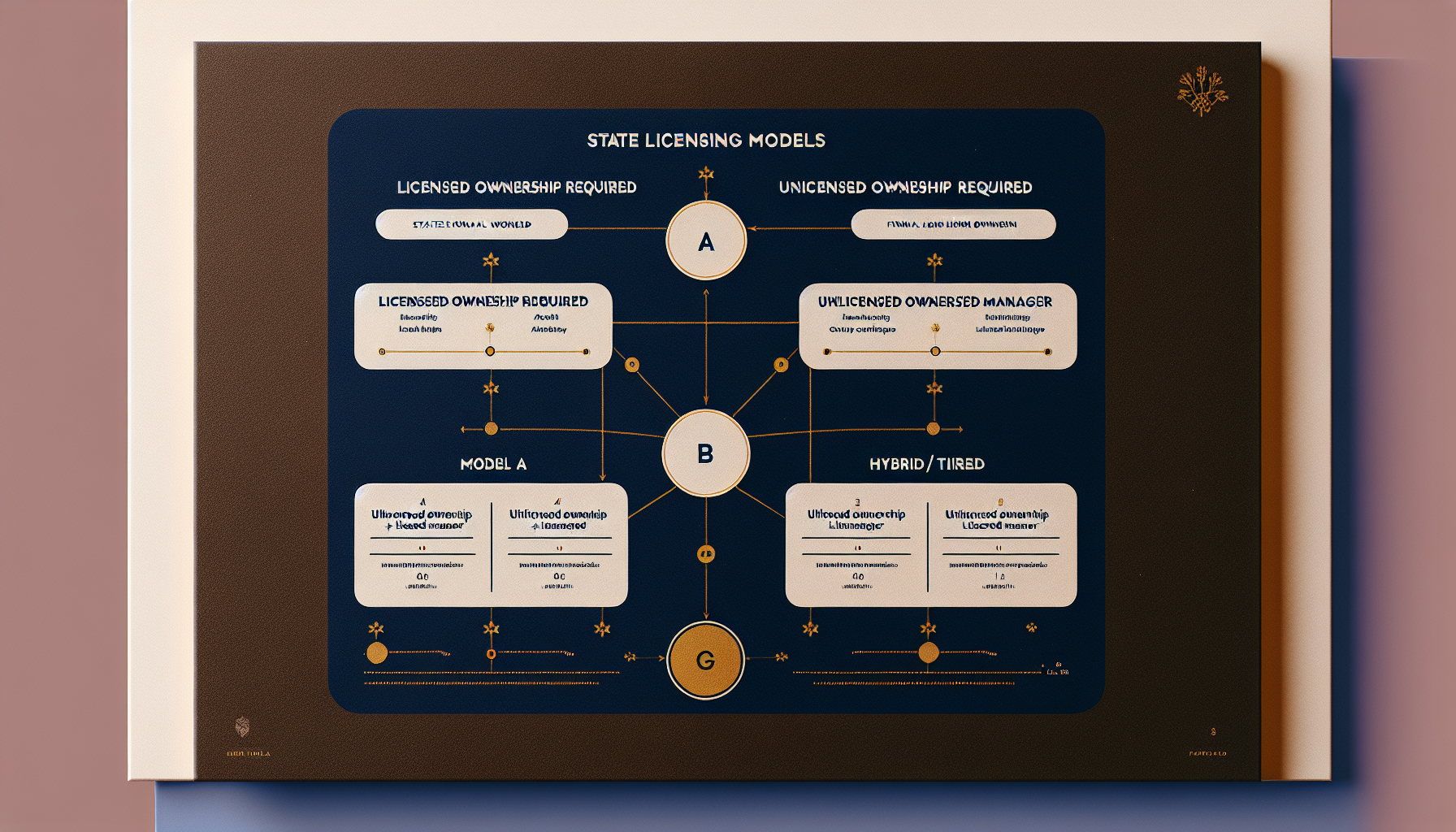
Model 1: Licensed Ownership Required
In these states, the person or entity that owns the funeral home must hold a funeral director or embalmer license. If you don’t have one, you can’t own the business. Period.
This is the most restrictive model. If you’re a career-changer from outside the funeral profession — a finance executive, a healthcare administrator, a business owner looking to diversify — this model means you need years of education and apprenticeship before you can close.
Georgia is a prominent example. The state requires funeral home owners to hold a valid funeral director license, which requires completion of an accredited mortuary science program, passing the NBE, and completing 3,120 hours of apprenticeship under a licensed funeral director. That’s roughly 18 months of full-time supervised work, on top of the educational requirements.
For a mid-career professional with no funeral service background, that’s a two-to-four-year commitment before you can legally take ownership.
Model 2: Unlicensed Ownership Permitted
In these states, anyone — individual or corporate entity — can own a funeral home, provided the business employs a licensed funeral director or manager who oversees operations.
California operates under this model. You can own a funeral establishment without holding a personal funeral director license, as long as you designate a licensed funeral director as the responsible manager of the establishment.
This is how private equity firms and large consolidators operate. Companies like SCI (Service Corporation International) and Park Lawn Corporation own hundreds of funeral homes across the country. Their executives and shareholders aren’t licensed funeral directors. They hire licensed professionals to run each location.
Texas falls largely into this category as well. The Texas Funeral Service Commission (TFSC) requires notification within 30 days of a change of ownership, but the new owner doesn’t need to be personally licensed. The establishment must have a licensed funeral director designated as the manager in charge.
Model 3: Hybrid and Tiered Systems
Some states fall between the two extremes. They may allow unlicensed ownership under certain conditions, require different levels of licensing for different ownership structures, or impose additional requirements on corporate owners versus individual owners.
A state might allow a corporation to own a funeral home without its shareholders being licensed, but require a sole proprietor to hold a license. Another might permit unlicensed ownership but require the owner to pass a jurisprudence exam or complete a shortened course on funeral law and consumer protection.
These hybrid systems require the most careful analysis. The rules often aren’t intuitive, and they change. State legislatures revisit funeral service regulations periodically, sometimes tightening ownership requirements in response to consumer protection concerns, sometimes loosening them to encourage market entry.
Why This Matters for Deal Structure
If you’re operating in a licensed-ownership state and you don’t have a license, you have limited options. You can spend years getting licensed. You can partner with a licensed individual who holds ownership while you provide capital. Or you can look for acquisition targets in states with more favorable ownership rules.
If you’re in an unlicensed-ownership state, your path is dramatically simpler. You still need to ensure the business employs licensed professionals, but you personally don’t need to go back to school.
Understanding which model applies to your target state should be the first step in your acquisition planning — before you engage a broker, before you sign an NDA, and certainly before you structure an LOI.
How Licensing Affects Your Deal Timeline
Licensing doesn’t just determine whether you can own a funeral home. It determines how fast you can close. And in acquisition deals, timeline is everything.
Best Case: 30–60 Days
This applies when:
- Your state allows unlicensed ownership
- The establishment license transfers with the business (equity deal) or the re-application is straightforward (asset deal)
- The seller’s licensed staff stays on post-closing
- No compliance issues exist on the current license
In states like Texas, where the requirement is essentially a 30-day notification of ownership change, the licensing component adds minimal time to your closing timeline. The bottleneck becomes financing, due diligence, and negotiation — not regulatory approval.
Moderate Case: 3–6 Months
This applies when:
- The state requires a full re-application for the establishment license upon change of ownership
- You need to pass a background check, submit facility inspection reports, or demonstrate financial responsibility
- Staff licensing transfers require state board review
- The state board meets on a fixed schedule (some boards meet quarterly, not monthly)
Many states fall into this bucket. The licensing requirements aren’t insurmountable, but they add meaningful time. If the state board only meets every 90 days and you miss a submission deadline, you’ve just added three months to your timeline.
This is where deal structure becomes critical. You may need extended exclusivity periods in your LOI to account for the licensing timeline. The seller needs to understand that the regulatory process takes time and that the deal can’t close until approvals are secured.
Worst Case: 2–4 Years
This applies when:
- Your state requires the owner to be personally licensed
- You don’t hold a funeral director or embalmer license
- You need to complete a mortuary science program, pass the NBE, and fulfill an apprenticeship requirement
This timeline changes the fundamental nature of the transaction. You’re not doing a straightforward business acquisition anymore. You’re embarking on a career change that eventually leads to a business acquisition.
Few sellers will wait two to four years for a buyer to get licensed. The business could change dramatically in that time. Key employees could leave. Market conditions could shift.
Deal Structure Implications
When licensing creates timeline risk, your deal structure needs to account for it.
Extended exclusivity. If regulatory approval takes six months, your LOI should include an exclusivity period that covers the full timeline plus a buffer. A 90-day exclusivity period is useless if your licensing takes 180 days.
Interim management agreements. In some cases, you can structure a deal where the seller (or a licensed manager) continues to operate the business under an interim management agreement while your licensing application is processed. This keeps the business running and gives the seller ongoing income while you work through regulatory requirements.
Phased closing. Some buyers structure transactions in phases: an initial agreement and deposit, followed by a formal closing once all licenses are approved. This gives both parties commitment while acknowledging the regulatory timeline.
Contingencies. Your purchase agreement should include a licensing contingency — a provision that allows you to exit the deal (and recover your deposit) if licensing is denied or if the regulatory timeline exceeds a specified period.
These structural elements aren’t optional in states with complex licensing requirements. They’re essential. Work with an attorney who understands both M&A and funeral service regulation to build them into your deal from the start.
The Licensing Due Diligence Checklist
Before you commit capital to a funeral home acquisition, work through these ten steps. Skip any of them and you risk discovering a deal-breaking licensing issue after you’ve already invested time, money, and emotional energy.
1. Identify your state’s funeral service regulatory board. Every state has one. Names vary — Board of Funeral Directors and Embalmers, Board of Mortuary Science, Funeral Service Commission. Find it. Bookmark it. You’ll be visiting their website repeatedly.
2. Determine whether the owner must be licensed. Call the state board directly. Don’t rely on secondhand information, internet forums, or even your attorney’s general knowledge. Ask the board: “Can an unlicensed individual or entity own a funeral establishment in this state?” Get the answer in writing if possible.
3. Check whether the establishment license transfers in a sale. In an equity purchase (buying the company), the license may stay with the entity. In an asset purchase (buying the assets), you almost certainly need a new establishment license. Understand which scenario applies to your deal structure.
4. Verify the current establishment’s compliance history. Request inspection reports and any compliance actions from the state board. Outstanding violations can condition or delay the transfer of an establishment license. Some states won’t approve a transfer until existing violations are resolved.
5. Confirm the licensing status of all key staff. Verify that every funeral director and embalmer on staff holds a current, valid license. Check for disciplinary actions, restrictions, or pending complaints. If a licensed employee’s status is compromised, that affects the establishment’s ability to operate.
6. Check reciprocity if you’re licensed in another state. If you hold a funeral director license in one state and you’re buying in another, don’t assume your license transfers. Contact the target state’s board and ask specifically about reciprocity, endorsement, or comity agreements. Get the requirements in writing.
7. Understand the timeline and costs for all required licensing actions. Get specific timelines from the state board. Ask about application processing times, board meeting schedules, inspection wait times. Licensing fees vary from a few hundred to several thousand dollars. Factor these into your acquisition budget and timeline.
8. Verify preneed license requirements. If the funeral home sells preneed contracts (and most do), there’s likely a separate preneed license with its own requirements — financial reporting, trust fund compliance, surety bonds. The preneed license may not transfer automatically with the establishment license. Preneed regulatory issues are among the most common deal complications in funeral home acquisitions.
9. Check crematory licensing separately. If the funeral home operates an on-site crematory, that’s a separate license with separate requirements. Crematory regulations have tightened significantly in recent years. Environmental permits, equipment certifications, and operator training requirements all apply. Don’t assume the crematory license is included in the establishment license.
10. Consult a funeral service attorney before signing anything. Not a general business attorney. Not your real estate lawyer. A funeral service attorney — someone who specializes in or has significant experience with funeral home regulatory matters. The NFDA can provide referrals. This is not a place to economize.
What Happens If You Get This Wrong
Licensing mistakes don’t create minor inconveniences. They create deal-killing, money-losing disasters. Here are four scenarios that play out regularly in funeral home acquisitions.
Scenario 1: Discovering Licensed Ownership Is Required After Signing the LOI
You find a funeral home with strong cash flow, negotiate a fair price, and sign a letter of intent. Your attorney starts drafting the purchase agreement. Three weeks in, someone finally checks the state licensing requirements and discovers that the owner must hold a funeral director license.
You don’t have one. Getting one will take two to three years. The seller isn’t going to wait. Your LOI deposit may or may not be refundable depending on how it was structured. You’ve spent thousands on legal fees and due diligence for a deal that was dead before it started.
This is entirely preventable. Licensing research should happen before you even contact a seller — not after you’ve signed documents.
Scenario 2: The Managing Director Resigns Post-Closing
You close on a funeral home in a state that allows unlicensed ownership. The establishment license is contingent on employing a licensed funeral director as the designated manager. The seller’s long-time funeral director — the person whose license supports your establishment license — resigns six weeks after closing.
Now you need to find a replacement licensed funeral director immediately. Depending on your market, that could take weeks or months. In the meantime, your establishment license may be in jeopardy. Some states give you a grace period (30 to 90 days is common). Others require immediate replacement.
The preventive measure: negotiate employment agreements or retention bonuses with key licensed staff as part of your acquisition. Build this into your first 90 days plan. Don’t assume current staff will stay just because you’re a nice person with good intentions.
Scenario 3: Violation History Conditions the Transfer
The funeral home you’re buying has a clean reputation in the community. Families love them. The Google reviews are stellar. But the state board file tells a different story: two inspection violations in the past three years, one related to preparation room ventilation, another to record-keeping.
The violations were resolved, but they’re still on the record. When you apply for the establishment license transfer, the board conditions the approval on a new full inspection, updated facility plans, and a compliance monitoring period. Your 60-day closing timeline just became a 6-month timeline.
The preventive measure: request the complete state board file on the establishment before you sign the LOI. Don’t take the seller’s word that “everything is clean.” Verify independently.
Scenario 4: Preneed Contracts Sold Without Proper Licensing
The funeral home has been selling preneed contracts for 20 years. It’s a significant revenue stream and a major part of the business’s value. During due diligence, you discover that the preneed license lapsed three years ago and contracts were sold during the lapse.
This isn’t just a licensing problem. It’s a potential consumer protection violation. The state could impose fines, require restitution, or condition any future licensing on resolution of the past violations. The trust funds backing those preneed contracts may be underfunded or improperly managed.
This scenario can crater the entire deal or dramatically reduce the price you should pay. Preneed compliance is a specialized area — make sure your due diligence covers it thoroughly.
State-by-State Resources
No single resource gives you a complete, current picture of every state’s funeral home licensing requirements. But these are the best starting points.

National Funeral Directors Association (NFDA) — The NFDA maintains a database of state licensing requirements and state regulatory board contact information. This is your best first stop for a general overview of any state’s requirements.
International Conference of Funeral Service Examining Boards (ICFSEB) — Administers the National Board Examination and maintains information about state-by-state exam requirements and reciprocity.
American Board of Funeral Service Education (ABFSE) — Accredits mortuary science programs. If you need to get licensed, this is where you find accredited programs in your state or region.
State board websites — Every state has a funeral service regulatory board with a public website. These sites contain current statutes, regulations, application forms, fee schedules, and board meeting calendars. Start with the Texas Funeral Service Commission or the Georgia Secretary of State’s funeral service page as examples of what to look for in your state’s board site.
A Critical Disclaimer
Licensing requirements change. State legislatures amend funeral service statutes. Regulatory boards update rules and interpretations. The information in this guide is current as of publication, but it is not a substitute for direct contact with your state’s regulatory board.
Before you make any acquisition decision based on licensing assumptions, call the board. Ask your specific questions. Get answers that apply to your specific situation. Document everything.
Funeral service regulation is one area where “I read it online” is not an acceptable basis for a six- or seven-figure business decision. Verify directly. Every time.
FAQ — Funeral Home Licensing for Buyers
Can I buy a funeral home if I’m not a licensed funeral director?
It depends entirely on your state. Some states allow unlicensed ownership as long as you employ a licensed funeral director to manage operations. Others require the owner to hold a personal license. Check with your state’s funeral service regulatory board before you start looking at acquisition targets.
How long does it take to get a funeral director license?
Typically two to four years, including completion of an accredited mortuary science program, passing the National Board Examination, and fulfilling your state’s apprenticeship requirement. Some states allow concurrent education and apprenticeship, which can shorten the total timeline. Others require sequential completion.
Does my funeral director license transfer to another state?
There is no automatic national reciprocity. Some states have reciprocity or endorsement agreements with specific other states, but the terms vary. You may need to pass a state-specific jurisprudence exam, complete additional apprenticeship hours, or meet other supplemental requirements. Contact the target state’s board directly.
What’s the difference between an establishment license and a personal license?
The establishment license applies to the funeral home as a business — the physical location and the entity that operates it. The personal license applies to individuals — funeral directors and embalmers who perform professional services. Both are required for a funeral home to operate, but they’re separate licenses with separate requirements.
Can I use an LLC or corporation to own a funeral home?
In states that allow unlicensed ownership, yes. Many funeral homes are owned by LLCs, S-corps, or C-corps. The entity structure you choose has implications for liability protection, tax treatment, and licensing. Some states have specific requirements for corporate ownership of funeral establishments.
What happens to the establishment license when I buy the business?
It depends on the deal structure. In an equity purchase (buying the ownership interest in the existing entity), the establishment license may remain with the entity. In an asset purchase, you’ll typically need to apply for a new establishment license. Either way, most states require notification of the change and may require board approval.
Do I need a separate license to operate a crematory?
In most states, yes. Crematory operations require a separate license with specific requirements for equipment, environmental compliance, operator training, and record-keeping. Don’t assume a funeral home establishment license covers crematory operations.
How much does licensing cost?
Direct licensing fees are relatively modest — typically a few hundred to a few thousand dollars for application and initial licensing, plus annual renewal fees. The real cost is indirect: education (mortuary science programs can run $10,000–$50,000+), time away from other income during apprenticeship, and legal fees for navigating the regulatory process. Budget $2,000–$5,000 for direct licensing costs and significantly more if you need to obtain a personal license from scratch.
Should I start the licensing process before I have a deal under contract?
If your state requires owner licensing and you don’t have one, absolutely. The licensing timeline is the longest lead item in your acquisition. Starting early gives you maximum flexibility when you find the right opportunity. Even if you’re in an unlicensed-ownership state, understanding the establishment licensing process in advance eliminates surprises during due diligence.
What’s the biggest licensing mistake buyers make?
Assuming the rules in their state are the same as the rules they’ve read about in articles or heard about from other buyers. Every state is different. The buyer who assumes Texas rules apply in Georgia — or vice versa — is the buyer who discovers a two-year licensing requirement after they’ve already committed to a deal. Research your specific state first. Everything else follows from that.