
Your lender doesn’t care about your passion for serving families. They care about whether you can service the debt.
That’s not cynicism — it’s how underwriting works. The business plan is the document where you prove, with specifics and numbers, that this particular funeral home generates enough cash to repay this particular loan with a comfortable margin. Generic templates downloaded from SCORE or the SBA website won’t do that. They’ll produce a business plan that looks like every other small business acquisition — and funeral homes aren’t every other small business.
Preneed trust obligations. Cremation mix shifts. Licensing requirements that vary by state. Embalmer staffing ratios. These are the variables that determine whether your deal cash-flows, and they’re the variables your lender needs to see addressed explicitly. Miss them, and your application goes to the bottom of the pile — or into the rejection folder.
This guide walks through every section of a funeral home acquisition business plan, with the funeral-specific elements that separate funded deals from declined ones.
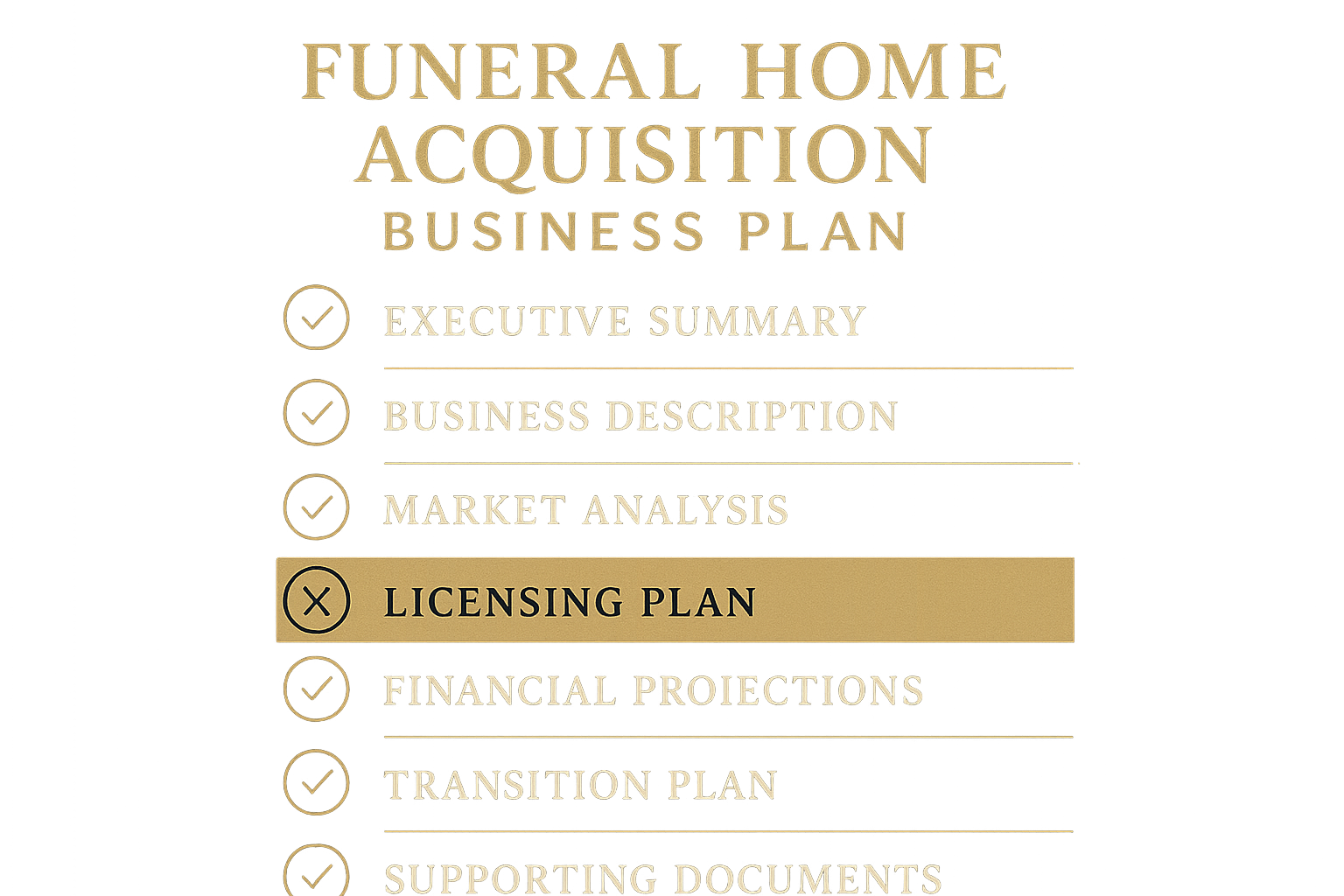
Why Generic Business Plan Templates Will Get Your Application Rejected
Every SBA lender and most conventional lenders require a written business plan for acquisition financing. That’s not optional. But the format of that plan matters as much as the content.
Generic templates are built for startups or retail businesses. They include sections on “product development roadmap” and “customer acquisition strategy” that make no sense for a funeral home acquisition. Worse, they omit the sections that lenders actually scrutinize in death care deals: preneed liability analysis, licensing transition plans, cremation mix impact on revenue per case, and disposition-specific margin modeling.
SBA loan officers who specialize in funeral home acquisitions — and the good ones at Preferred Lenders see several per year — have a mental checklist. They’re looking for evidence that you understand the unique economics of this industry. A plan that reads like it could describe a laundromat or an auto body shop signals that you don’t.
The business plan is a sales document. You’re selling the lender on three things simultaneously:
- The business is sound. Historical financials, market position, and growth trajectory justify the purchase price.
- You are capable. Your background, licensing plan, and operational strategy demonstrate you can run this business without the seller.
- The debt is safe. Cash flow projections show a debt service coverage ratio well above the lender’s threshold, even under conservative assumptions.
Every section that follows serves one or more of those three objectives. If a paragraph doesn’t advance at least one of them, cut it.
The Executive Summary: Tell the Story of This Specific Deal
The executive summary is the first page your lender reads and the last page you should write. It compresses the entire plan into a narrative that answers: what are you buying, why is it a good business, and how will you repay the loan?
Lead with specifics, not generalities. Don’t open with “The death care industry is a $23 billion market.” Your lender knows that. Open with the deal:
Smith Family Funeral Home, located in Springfield, IL, has served the community since 1974. The business completed 187 cases in 2025, generating $1.42 million in revenue and $385,000 in seller’s discretionary earnings. The proposed acquisition price of $1.35 million represents a 3.5x SDE multiple, consistent with industry benchmarks for firms of this size.
That’s the kind of opening that keeps a loan officer reading.
After the deal summary, cover these elements in order:
- Your background. Relevant experience, industry exposure, and — critically — your licensing status or licensing plan. If you’re not currently a licensed funeral director, state exactly how you’ll meet your state’s ownership requirements.
- The financing request. Total acquisition cost, your equity injection (typically 10–20% for SBA 7(a) loans), and the loan amount requested. Break down the use of proceeds: business purchase, real estate, working capital, capital improvements.
- The thesis in one sentence. Why this business, in this market, at this price, makes financial sense under your ownership.
Keep the executive summary to one page. Two pages maximum if the deal structure is complex (multiple entities, separate real estate, earnout provisions). Every claim you make here must be substantiated in the sections that follow.
The Business Description: What You’re Actually Buying
This section answers the lender’s most basic question: what does this business do, and how does it make money?
For a funeral home, that answer is more layered than most industries. You’re buying a service business, a real estate asset, a trust management operation, and a community institution — simultaneously.
Business History and Facilities
Start with the basics. When was the business established? How many owners has it had? What’s the facility — square footage, chapel capacity, number of preparation rooms, viewing rooms, on-site crematory (if applicable), parking capacity.
Lenders want to know the condition of the physical plant. A funeral home built in 1965 with original HVAC and no ADA compliance upgrades represents a different capital expenditure profile than a facility renovated in 2018. Be honest about deferred maintenance — your lender will find it during the appraisal anyway.
Case Volume and Disposition Mix
This is the core operating metric. Present 3–5 years of case volume data, broken down by disposition type:
| Year | Traditional Burial | Cremation w/ Service | Direct Cremation | Other | Total |
|---|---|---|---|---|---|
| 2023 | 78 | 34 | 51 | 5 | 168 |
| 2024 | 72 | 38 | 58 | 4 | 172 |
| 2025 | 65 | 42 | 67 | 6 | 180 |
The trend matters more than the absolute numbers. In the example above, total cases are growing — but burial is declining and direct cremation is rising. That shift compresses average revenue per case. Your lender needs to see that you understand this and have modeled it into your projections.
The national cremation rate reached approximately 63% in 2025 according to the NFDA. If the business you’re buying is significantly above or below that average, explain why (demographics, cultural composition of the service area, competitive dynamics, pricing strategy).
Revenue Breakdown by Service Line
Don’t just report total revenue. Break it down:
- At-need service fees (arrangement, embalming, facilities use, automotive)
- Merchandise (caskets, urns, vaults, keepsakes)
- Cash advance items (flowers, obituaries, death certificates — passed through at cost or with margin)
- Preneed revenue (recognized when contracts are fulfilled)
- Crematory revenue (if operating an on-site crematory, including third-party cremations)
- Other (monument sales, reception services, pet cremation)
Revenue per case is the metric lenders and valuators focus on. Average revenue per case for NFDA-member firms is approximately $7,800 for full-service burial and $3,500 for direct cremation. Position the business relative to these benchmarks and explain any variance.
Preneed Obligations
This is where funeral home acquisitions diverge sharply from other small business deals. The preneed book is both an asset and a liability.
What lenders need to see:
- Total number of preneed contracts outstanding
- Total face value of obligations
- Total funded amount (in trust or insurance)
- Funding ratio (funded amount ÷ face value). Below 90% is a red flag.
- Historical conversion rate (preneed contracts fulfilled per year as a percentage of total outstanding)
- Trust type (state-regulated trust vs. insurance-funded)
- Any unfunded or underfunded obligations the buyer will assume
A well-funded preneed book with 50+ annual conversions is a revenue pipeline. An underfunded book with stale contracts from the 1990s is a time bomb. Your business plan must make clear which one you’re inheriting.
Staff and Licensed Directors
List current staff by role: licensed funeral directors, embalmers, support staff, administrative. Note any dual-licensed directors (funeral director + embalmer), part-time vs. full-time, and tenure.
For SBA-backed deals, the lender wants assurance that the business doesn’t collapse if the seller walks away on day one. If the seller is the only licensed director, your plan needs to explain exactly how you’ll maintain licensed coverage during the transition — even if that means the seller stays under a consulting agreement.
Market Analysis: Prove You Understand the Service Area
Lenders don’t fund businesses in a vacuum. They fund businesses in specific markets. Your market analysis must demonstrate that the service area can sustain this business under your ownership — and ideally grow.
Define the Service Area
Funeral homes draw from a defined geographic radius, typically 10–20 miles in suburban markets and 25–50 miles in rural areas. Define yours using ZIP codes or county boundaries. Map it.
Demographics and Death Rate Data
Pull county-level or ZIP-level data from the U.S. Census Bureau and CDC Wonder to establish:
- Total population and 5-year growth trend
- Population 65+ as a percentage of total (national average: ~17%). This cohort drives near-term case volume.
- Crude death rate (deaths per 100,000 population). The national average is approximately 880 per 100,000. Higher rates indicate an older population — more cases per capita.
- Projected deaths using Census population projections and age-specific mortality rates
This data is free and publicly available. Not including it tells the lender you didn’t bother to look.
Competitive Landscape
Identify every funeral home within the service area. For each competitor, note:
- Name and location
- Estimated case volume (state death certificate filings are often available through FOIA requests or state vital records offices)
- Whether they’re independently owned, corporate-affiliated (SCI/Dignity Memorial, Carriage Services, Park Lawn), or part of a regional platform
- Price positioning (general price lists are required to be available by the FTC Funeral Rule)
Calculate the business’s market share: its case volume divided by total deaths in the service area. A funeral home handling 180 cases in a county with 900 annual deaths has a 20% market share. That number is your baseline.
Cremation Trends in This Market
Don’t cite national cremation rates and call it done. Pull the state-specific and, if available, county-specific cremation data. Some states (Washington, Oregon, Nevada) are above 80%. Others (Mississippi, Alabama, Kentucky) remain below 40%. The business you’re buying operates in a specific market with a specific cremation trajectory. Model it.
The cremation rate directly impacts your revenue projections. A 5-percentage-point shift from burial to cremation over your projection period could reduce average revenue per case by $500–$1,000. Your plan must show you’ve accounted for this.
The Licensing Plan (The Section Most Buyers Forget)
If you are not a licensed funeral director, this section can make or break your application. Lenders have rejected otherwise-strong applications because the buyer had no coherent plan for meeting state licensing requirements.
Why This Matters to Lenders
Funeral homes operate under state-issued establishment licenses. In most states, the establishment license requires a licensed funeral director to be in responsible charge. Some states require the owner to hold a license. Others allow unlicensed ownership with a licensed manager.
If your state requires owner licensure and you’re not licensed, the lender has a legitimate concern: can you legally operate this business on day one?
What to Include
State requirements. Name your state’s licensing board and cite the specific statute or regulation. Specify whether owner licensure is required or whether a managing director model is permitted.
Your current status. If you hold a funeral director license, state the license number and issuing state. If you hold a license in a different state, describe the reciprocity process.
If you’re not licensed:
- Are you enrolled in or planning to enroll in a mortuary science program? Which one? Estimated completion date?
- Will you employ a licensed managing funeral director during the transition? Do you have a candidate identified?
- Does the seller’s consulting agreement include maintaining their license at the establishment during the transition period?
- What is the realistic timeline from closing to full licensure — 6 months, 12 months, 24 months?
The transition plan. Show the lender a timeline: closing date → seller consulting period → managing director coverage → your licensure completion → full operational independence. Every gap in licensed coverage is a risk the lender must accept. Eliminate the gaps.
Lenders who specialize in SBA funeral home acquisitions have seen deals fall apart because the buyer assumed licensure would be “easy to figure out” post-closing. Don’t be that buyer.
Financial Projections: The Numbers That Get Deals Funded
This section is where business plans succeed or fail. Your projections must be specific, conservative, defensible, and directly tied to the historical performance you documented in the business description.

Build From the Historical Base
Start with the last three years of actual financials. Your Year 1 projections should be a modest adjustment from the most recent year — not a reimagining. Lenders view projections that deviate dramatically from historical performance in either direction as either naive or dishonest.
Project forward 3–5 years. Most SBA lenders require three years. Five years strengthens your case if the story is credible.
The DSCR Target
The debt service coverage ratio is the single most important number in your projection. It tells the lender whether the business generates enough cash to pay the loan.
DSCR = Net Operating Income ÷ Annual Debt Service
For SBA 7(a) loans, the standard minimum is 1.25x — meaning the business must generate $1.25 in operating income for every $1.00 in debt payments. Some lenders will go as low as 1.15x for strong deals with substantial collateral, but that’s the absolute floor.
Calculate DSCR for every year of your projection. If Year 1 dips below 1.25x because of transition costs, explain why and show recovery in Year 2. If DSCR never reaches 1.25x under conservative assumptions, the deal may be over-leveraged — reconsider the price, the loan structure, or the deal itself.
Revenue Modeling: Cremation Mix Matters
Don’t project flat revenue growth. Model it by disposition type:
- Burial cases: Likely declining 2–5% annually in most markets
- Cremation with service: Growing in most markets as families choose memorialization without casket burial
- Direct cremation: Growing, but at the lowest revenue per case ($2,000–$4,000)
Apply realistic revenue per case to each category. A funeral home with 180 total cases and $1.4M in revenue today may project 190 cases but only $1.38M in revenue five years out if the cremation mix shifts enough. Your lender needs to see that you understand this dynamic and haven’t papered over it with a blanket “3% annual growth” assumption.
Monthly Cash Flow: Year 1
Annual projections aren’t enough for Year 1. Build a 12-month cash flow showing:
- Monthly revenue (funeral homes have modest seasonality — January–March typically 10–15% above average in northern markets)
- Cost of goods sold by month
- Payroll (your largest fixed cost, typically 35–45% of revenue)
- Occupancy costs
- Debt service payments
- Working capital cushion
This monthly view reveals whether you’ll have cash shortfalls during slow months. If you will, show how your working capital reserve covers them.
Sensitivity Analysis
Run at least two downside scenarios:
- Case volume decline of 10%. What happens to DSCR if you lose 18 cases in a year?
- Revenue per case decline of 8%. What if cremation mix shifts faster than expected?
If DSCR stays above 1.15x under both stress scenarios, you’ve demonstrated that the deal survives adversity. That’s what separates funded applications from declined ones.
Common Projection Mistakes
Hockey-stick growth. If you’re projecting 20% revenue growth in Year 3 from a business that’s grown 2% annually for a decade, you need an extraordinary justification. Lenders have seen hundreds of these plans. They know what “aspirational” looks like.
Ignoring preneed conversion timing. Preneed contracts convert to at-need revenue when the contract holder dies. Conversion rates are relatively predictable (typically 3–8% of the book annually), but the revenue isn’t “new” — it’s fulfillment of an existing obligation. Double-counting preneed conversions and at-need growth is a common error that inflates projections.
Underestimating transition costs. The first 6–12 months post-acquisition typically include seller consulting fees ($3,000–$8,000/month), deferred maintenance catch-up, technology upgrades, and marketing spend to announce the transition. Budget $50,000–$100,000 in non-recurring transition costs for a mid-size firm.
Omitting your own compensation. If you’re replacing the seller as the day-to-day operator, your compensation must be in the projections. SBA lenders will add it back if you leave it out — and it will lower your DSCR.
The Transition and Operations Plan
Lenders know that ownership transitions are the highest-risk period for any small business. For funeral homes, the risk is amplified because the business runs on community trust and personal relationships. Your plan must address continuity directly.
Service Continuity Strategy
The families who call during your first week don’t care that you just closed on the building. They need the same level of service they would have received under the prior owner. Your plan should explain:
- How you’ll maintain service quality during the transition
- Who answers the phone at 2 a.m. on day one
- Whether you’ll keep the business name (most buyers do, at least initially)
- How you’ll communicate the ownership change to the community (clergy, hospice partners, nursing home administrators, florists, cemeteries)
Seller Consulting Agreement
Most funeral home acquisitions include a consulting or transition agreement with the seller. This is standard and lenders expect to see it.
Typical terms:
- Duration: 6–24 months. Shorter for buyers with industry experience. Longer for career-changers.
- Compensation: $3,000–$8,000/month for part-time consulting, higher if the seller continues directing funerals during the transition.
- Scope: Introductions to families and referral sources, operational training, mentorship on community dynamics.
- Non-compete: The agreement should include a non-compete clause covering the service area for 3–5 years post-transition.
If the seller has agreed to a consulting period, attach the term sheet or draft agreement as a supporting document.
Staff Retention
Staff turnover during a transition can cripple a funeral home. Families call because they trust specific people — not the sign on the building.
Your plan should address:
- Which key employees you intend to retain
- Whether you’ll offer retention bonuses, salary increases, or benefit improvements
- How you’ll communicate with staff before and after closing
- Contingency plans if critical staff resign (especially licensed directors)
Technology and Marketing
Lenders increasingly expect a digital competency plan. Cover:
- Case management software (current system and any planned upgrades)
- Website and online presence (Google Business Profile, reviews, SEO)
- Marketing budget — industry standard is 3–6% of collections for established firms, potentially higher in Year 1 to announce the transition
- Online arrangement and pre-planning tools (growing expectation from younger families)
Operational Timeline
Lay out priorities in phases:
First 90 days: Stabilize operations. Meet every referral source personally. Retain staff. Complete all regulatory filings. Audit the preneed book independently. For a detailed playbook, see our first 90 days guide.
Months 4–12: Implement operational improvements. Upgrade technology. Launch updated marketing. Establish your own community relationships.
Year 2+: Growth initiatives. Consider adding service lines (pet cremation, reception services, grief counseling referral programs). Evaluate whether an on-site crematory pencils out if you’re currently outsourcing. Explore preneed growth strategies.
Supporting Documents Lenders Expect
The business plan tells the story. The supporting documents prove it. SBA lenders in particular have a standardized documentation checklist. Missing items delay your application — or kill it.
Personal Documents
- Personal Financial Statement (SBA Form 413) for each owner with 20%+ ownership
- Personal tax returns — 3 years, all schedules
- Resume or CV — emphasize management experience, industry exposure, and financial acumen
- Credit authorization — the lender will pull your personal credit
Business Documents (From the Seller)
- Business tax returns — 3 years, all schedules
- Year-to-date P&L and balance sheet
- Accounts receivable aging report (funeral homes often carry 60–90 day receivables from insurance assignments)
- Equipment list with estimated values
- Vehicle titles and condition reports
- Preneed trust statements — last 3 years, audited if available
- Insurance policies (general liability, professional liability, property, workers’ comp, vehicle)
- Current establishment license and funeral director licenses for all staff
- Any pending litigation, complaints, or regulatory actions
Deal Documents
- Signed Letter of Intent (LOI)
- Business valuation or appraisal (independent, not the seller’s broker opinion of value)
- Real estate appraisal (if real property is included in the purchase, required for SBA)
- Collateral list — lender needs to identify what secures the loan
- Asset purchase agreement or stock purchase agreement (draft is fine at application stage)
Documents You Prepare
- The business plan (this document)
- Financial projections — 3–5 year income statement, balance sheet, cash flow
- Licensing plan (see above)
- Transition timeline
Organize everything in a single digital package. Label files clearly. Lenders review dozens of applications — the ones that are well-organized get reviewed first.
FAQ — Funeral Home Acquisition Business Plan
How long should the business plan be?
25–40 pages including financial exhibits. Shorter plans lack substance. Longer plans suggest you’re padding. The narrative sections should total 15–20 pages. The remainder is financial projections, tables, and supporting exhibits.
Do I need a business plan if I’m using seller financing?
If the seller is financing the entire deal, they may not require a formal business plan. But you should write one anyway. The process of building the plan forces you to pressure-test assumptions that your enthusiasm might otherwise skip. And if you need bank financing for any portion — including working capital — the lender will require one.
Can I hire someone to write the business plan?
You can, and some funeral home business consultants (Foresight Companies, Kates-Boylston, independent advisors) offer this service. Expect to pay $3,000–$10,000. But you must own the content. Lenders will ask questions about the projections, and “my consultant wrote that” is not an acceptable answer in an underwriting interview.
What if the business doesn’t meet the 1.25x DSCR threshold?
You have four options: negotiate a lower purchase price, increase your equity injection (which reduces the loan amount and debt service), restructure the loan terms (longer amortization lowers monthly payments), or walk away. Forcing projections to show 1.25x DSCR when the math doesn’t support it will get caught in underwriting.
How do I project case volume for a funeral home?
Start with historical case volume and the business’s market share. Then project deaths in the service area using Census population data and CDC mortality rates. If the 65+ population is growing, case volume should grow proportionally — assuming you maintain market share. Be conservative: projecting market share gains requires a specific strategy, not just optimism.
What’s the biggest mistake first-time buyers make in their business plan?
Treating the business plan as a formality rather than a decision-making tool. The buyers who get funded are the ones who built the plan to convince themselves first — and the lender second. If your own projections don’t make you confident the deal works, the plan isn’t done.
Do SBA lenders specialize in funeral home acquisitions?
Some do. The SBA Preferred Lender program includes banks with death care industry experience. Working with a lender who has closed funeral home deals before significantly reduces friction — they know what to look for, and they won’t be surprised by preneed trusts or establishment licensing requirements. Your broker, attorney, or industry contacts can often recommend SBA lenders with funeral home experience.
Should I include a preneed growth plan in my projections?
Yes, but be careful. Preneed sales are a long-term revenue pipeline, but the cash isn’t recognized until the contract is fulfilled — which could be 10–30 years later. Show preneed as a strategic initiative, but don’t let preneed growth inflate your near-term revenue projections. Lenders understand the difference between preneed bookings and at-need revenue.
Related Reading
Resources
The business plan is where preparation meets persuasion. Every page should demonstrate that you’ve done the homework — on the business, the market, the financing, and yourself. Lenders don’t fund enthusiasm. They fund evidence.
This article is educational and does not constitute financial, legal, tax, or investment advice. Consult qualified professionals for advice specific to your situation.