
You get a call at 9 p.m. A son wants his father cremated. The next morning, the estranged wife walks in with a marriage certificate and demands burial. Both believe they have the right to direct disposition. You have a body in your care and a business that can’t afford a lawsuit.
This is not an edge case. Every funeral director with more than two years of experience has faced some version of it. The question isn’t whether you’ll encounter contested dispositions — it’s whether your business has the policies in place to survive them.
This guide maps the legal framework, the scenarios that generate claims, and the operational protocols that protect you. If you’re acquiring a funeral home, it also gives you the due diligence questions you need to ask before you close.
1. The Disposition Authority Hierarchy: Who Actually Has the Legal Right to Direct You
Funeral directors don’t get to decide who’s in charge. State law does. And the hierarchy is more specific — and more rigid — than most buyers expect.
The General Priority Order
In most states, the right to control disposition follows a statutory sequence:
- Designated agent — a person named in a signed, witnessed document (sometimes called a “funeral agent” or “disposition agent” form) specifically authorizing that individual to direct disposition. This typically supersedes all family members.
- Surviving spouse — legal spouse, not common-law or domestic partner in most states.
- Adult children — majority rule applies in several states when there are multiple children with equal standing.
- Parents
- Siblings
- Extended family — grandparents, aunts, uncles, or closest next-of-kin by degree
- Public administrator — if no family is available or identifiable
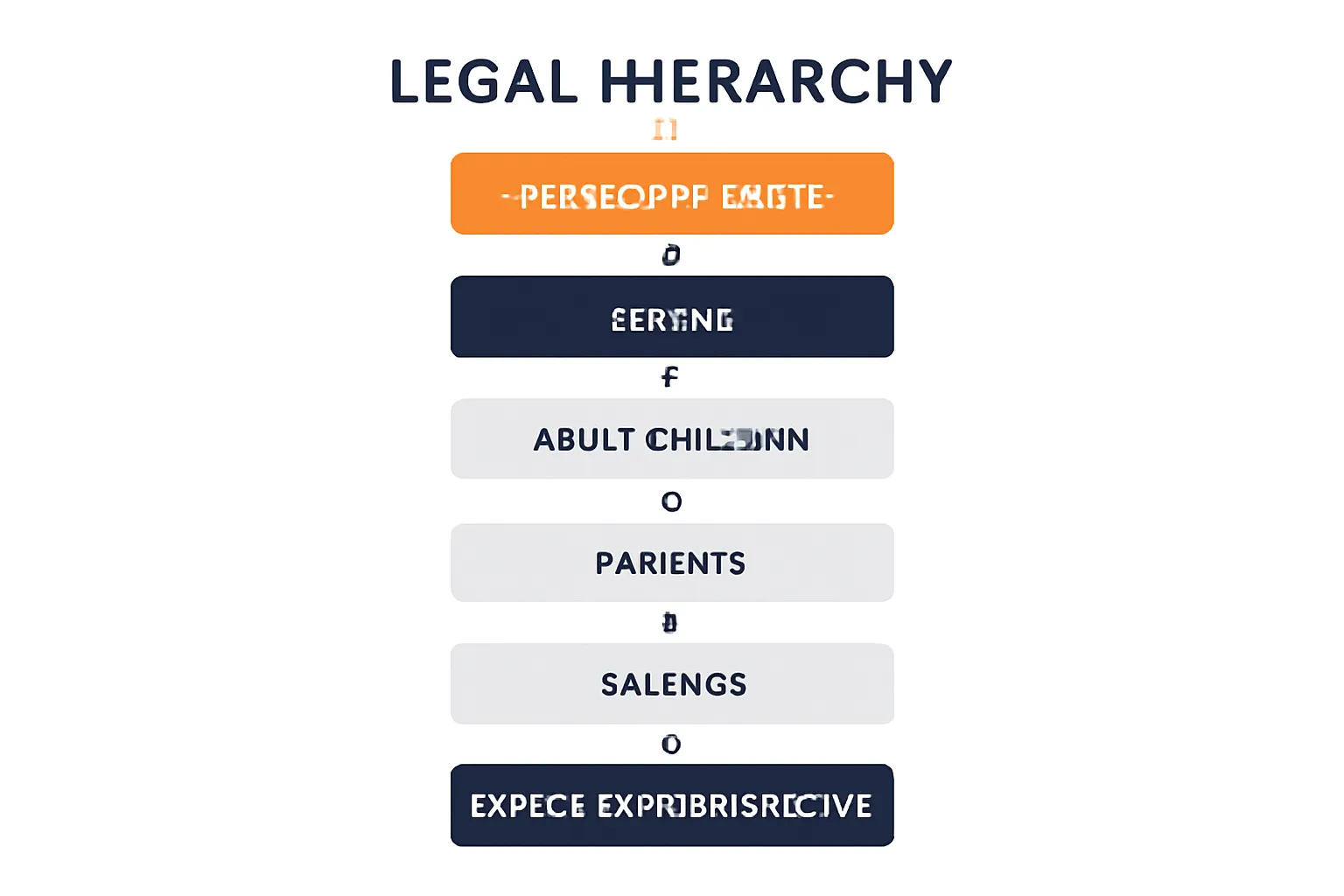
This sequence varies by state. State licensing requirements dictate whether your state follows a strict statutory hierarchy, a majority-of-class rule, or gives courts more discretion.
For a full state-by-state breakdown of disposition authority laws, End of Life Tools maintains a comprehensive reference.
The Will vs. Body Authority Distinction
This trips up buyers who come from business backgrounds. A decedent’s will governs property distribution — not body disposition. Even if someone is named executor of an estate, that does not automatically give them disposition authority.
The two legal tracks run separately. An executor who is not the next-of-kin in the statutory hierarchy cannot override the family member who holds disposition authority.
Courts have been consistent on this. Do not let an executor’s legal standing in probate create a false sense of authority over the body.
Designated Agent Documents: Superseding the Hierarchy
Several states — including Virginia, California, Florida, and New York — allow individuals to execute a designated agent form while alive that legally supersedes family members. When this document is valid and presented, the named agent controls disposition.
The catch: the form must meet state-specific execution requirements. Witnesses, notarization, and form language vary. Everplans has a useful overview of how this authority works across states.
When you acquire a funeral home, find out whether their authorization forms have been updated to account for designated agent documents. Old forms that don’t contemplate this create gaps.
2. The Five Dispute Scenarios You Will Face
Understanding the hierarchy is one thing. Recognizing how disputes materialize in practice is another. These are the five patterns that generate the most litigation.
Scenario 1: Burial vs. Cremation Splits
The decedent expressed a preference — verbally, in a note, or in a will — but the family is divided. One side wants cremation. The other insists on burial.
Key point: verbal expressions and written wishes in a will are generally not legally binding on the person holding disposition authority. They are advisory. The person with legal authority can override them.
That doesn’t make it feel less explosive. If you proceed with cremation at the request of the authority-holder, and the other side later argues the authority was disputed, you face an irreversible mistake. Cremation is permanent. There is no remedy other than damages.
Scenario 2: Estranged Spouses
Legal separation does not dissolve a marriage. Until a divorce decree is finalized, a spouse retains legal next-of-kin status in most states. That means an estranged spouse — someone the decedent hadn’t spoken to in years — may hold disposition authority over the objections of adult children, a live-in partner, or anyone else the decedent actually wanted involved.
This scenario is especially common when the decedent died younger than expected (accident, overdose, sudden illness) before divorce proceedings concluded.
Verify marital status. Do not assume that because adult children are present and engaged that the spouse is out of the picture.
Scenario 3: Late Designated Agent Documents
The decedent executed a designated agent form six months ago. No one told the funeral home. A family member calls first and begins making arrangements. Three days in, the designated agent surfaces with the document.
If you’ve already moved forward — committed to a cremation date, signed a cremation authorization — you are exposed. The question becomes whether you acted in good faith on the information available, and whether your state’s statute provides good-faith protection to funeral directors.
Not all states do. Some impose strict liability for proceeding without proper authority.
Scenario 4: Unmarried Partners
A domestic partner or long-term significant other has no disposition authority unless they are named in a valid designated agent form. Many people don’t know this. They assume years of cohabitation or a registered domestic partnership translates to legal standing.
In most states, it doesn’t. The partner may be entirely shut out by family members who hold statutory priority — even family members the decedent was estranged from.
You will face these conversations in the arrangement conference. Your arrangement conference process needs a protocol for this. Staff need to be trained to handle these conversations with empathy while holding the legal line.
Scenario 5: Cross-State Disputes
The decedent died in your state but lived in another. Family members are split between states. One side is citing your state’s law. The other is citing the state of legal residence or the state where a prior arrangement was made.
Generally, the law of the state where disposition occurs controls. But this gets complicated when designated agent documents were executed under another state’s statutes. Validity may turn on whether your state’s recognition rules extend to out-of-state documents.
When the decedent has cross-state ties, get your attorney on the phone before you proceed.
3. The Liability Exposure: What Happens When You Proceed Based on the Wrong Authority
The legal consequences of a wrongful disposition are severe, business-threatening, and in the case of cremation — irreversible.
Wrongful Cremation
This is the highest-stakes exposure in funeral home operations. If you cremate remains without proper authorization from the legally recognized authority-holder, you face:
- Civil liability for emotional distress damages — courts have consistently held that families can recover for mental anguish from wrongful cremation, even without physical injury
- Regulatory action and license suspension — state funeral boards treat unauthorized cremation as a serious disciplinary matter
- Criminal exposure in some states — a minority of states have statutes that criminalize unlawful disposition
Damages in wrongful cremation cases are not theoretical. Jury verdicts in the range of $500,000 to $1.5 million are documented in the case law. Legal analysis of recurring family dispute patterns in funeral home liability shows the claims are increasing in frequency.
Emotional Distress Claims
Even when disposition is reversible — a burial contested by a competing family faction — proceeding without verified authority exposes you to intentional infliction of emotional distress claims. Courts don’t require physical injury. Families have prevailed on claims that the funeral home caused severe emotional harm by disregarding their legal rights.
The threshold for “outrageous conduct” in these cases is lower than in typical tort law because courts treat the death context as inherently sensitive.
Injunctive Relief
Before any body has been disposed, a family member with a competing claim can seek an emergency court injunction to halt the funeral home’s actions. When this happens:
- You are legally prohibited from proceeding
- The body is in your facility, generating costs
- The litigation clock has started
This is operationally disruptive and expensive regardless of outcome. A clear dispute-hold policy — discussed below — is your first line of defense.
Insurance Gaps
Review your professional liability coverage carefully. Standard funeral home E&O policies often exclude or limit coverage for claims arising from unauthorized cremation. The exclusion language matters. An uncovered wrongful cremation claim is a direct balance sheet event — not something your insurer absorbs.
Before closing on an acquisition, get your litigation risk management framework reviewed by counsel who understands funeral home-specific coverage.
4. The Operational Protocols That Protect Your Business
Documentation and policy are your defense. Not instinct, not relationship, not how the previous owner handled it for thirty years.

Written Authorization Requirements — Non-Negotiable
Every disposition requires a signed cremation or burial authorization from the legally recognized authority-holder. Not verbal. Not texted. Not relayed through another family member.
Your authorization form should:
- Capture the signatory’s relationship to the decedent
- Include a representation that no higher-priority authority exists
- Require disclosure of any known disputes or competing claimants
- Include a hold-harmless clause, to the extent enforceable under state law
The NFDA provides operational guidance on authorization form best practices. Review their current recommendations when you onboard a new location.
Authority Verification Checklist
Before any irreversible action, staff should work through a written checklist:
- Identify the claimed authority-holder and their relationship
- Request documentation (marriage certificate, birth certificate, death certificate for prior-priority persons)
- Confirm no living person holds higher statutory priority
- Ask directly: “Is there anyone else in the family who might have a competing claim or who disagrees with this decision?”
- Check for any designated agent document on file or referenced in the decedent’s paperwork
- If cross-state ties exist, confirm applicable law with counsel
- Obtain written authorization with relationship representation
This isn’t bureaucracy. It’s a documented record showing you acted in good faith based on the information available. That documentation is the difference between a defensible position and an indefensible one.
Dispute Hold Policy
When a competing claim surfaces — before or after arrangements begin — implement a formal hold immediately. This means:
- No irreversible actions until authority is legally resolved
- Written notification to both competing parties that a hold is in effect
- Documentation of when the dispute was identified and what steps were taken
- A defined escalation path: manager review, then legal counsel, then court order if necessary
Train your staff to recognize dispute indicators: family members arriving separately, conflicting statements about the decedent’s wishes, a family member who asks whether a spouse or sibling has already called.
Early identification is everything. A hold before cremation authorization is issued is infinitely easier to manage than a hold after the retort has been scheduled.
When to Require a Court Order
Some situations require judicial resolution before you proceed. These include:
- Competing claimants with genuinely equal statutory priority who cannot reach agreement
- A designated agent document with questionable validity
- A situation where the legal authority-holder is directing disposition contrary to what you have strong reason to believe is a fraudulent claim
- Any cross-state dispute involving inconsistent applicable law
Requiring a court order is not obstruction. Courts understand that funeral homes cannot adjudicate family disputes. When you document your position clearly and communicate it professionally, you are not the villain — you are protecting all parties, including the family.
The FTC Funeral Rule also requires that you provide itemized pricing and transparency about consumer rights. Compliance with the Funeral Rule does not insulate you from disposition liability, but it establishes baseline operational credibility that matters in any regulatory proceeding.
5. Due Diligence Question: Has the Target Ever Been Caught in a Disposition Dispute?
When you’re evaluating a funeral home acquisition, disposition disputes are a direct indicator of both liability exposure and operational quality. Here’s how to investigate.
Seller Questions to Ask Directly
Don’t soften these. Ask them directly:
- Has the business ever been subject to a lawsuit or demand letter involving alleged wrongful cremation or unauthorized disposition?
- Has the business ever received a complaint from a state funeral board related to a disposition authorization issue?
- Has the business ever implemented a dispute hold and, if so, how many times in the past five years?
- Are there any open or unresolved family disputes involving remains currently in the business’s care?
Require written representations in the purchase agreement. Unresolved claims don’t disappear at closing — they transfer with the business if you don’t structure the deal to address them.
Board Records and Regulatory History
Your due diligence checklist should include a regulatory history pull. Contact the state funeral board directly. Many boards maintain public complaint records and disciplinary histories.
Searching the state board for complaints is a step that buyers routinely skip. Don’t. An unresolved complaint or a prior censure related to authorization failures tells you something about operational culture that the seller’s income statement won’t.
Authorization Form Review
Request a copy of the current cremation and burial authorization forms. Have counsel review them against state requirements. Specifically:
- Does the form capture the relationship of the signatory?
- Does it ask about competing claimants?
- Does it address designated agent documents?
- Has the form been updated within the past three years?
Old, generic forms are a red flag. They suggest the seller has not kept pace with statutory changes and may not have been capturing the documentation necessary to defend a disputed claim.
Review the Arrangement Conference Process
Ask to see the arrangement conference intake process — the workflow used to gather family information at the time of need. A well-run funeral home will have a documented intake sequence that includes authority verification as a standard step.
If the answer is “the director just handles it” with no written protocol, that tells you the business is operating on individual judgment rather than documented process. Individual judgment doesn’t defend claims. Documentation does.
What This Means for Your Acquisition Decision
Disposition disputes are a recurring feature of funeral home operations — not an aberration. The legal exposure is real, the damages are substantial, and the damage is sometimes irreversible.
What separates well-run operations from liability-prone ones is not whether they face disputes. It’s whether they have the written policies, trained staff, and documentation practices to manage disputes before they become claims.
When you’re evaluating an acquisition, treat the authorization process like any other operational system. Audit it. Ask the hard questions. Review the forms. Pull the board history.
A funeral home with a clean track record on disposition disputes — and the systems to prove it — is worth more than one that has been lucky. And a funeral home with unresolved exposure in this area is a risk you’re pricing, whether you know it or not.
The Takeaway
Every funeral director will face contested dispositions. The law is rigid, the hierarchy is specific, and the consequences of proceeding based on the wrong authority are severe — especially for cremation, which is irreversible.
Protect your business with written authorization requirements, a verification checklist, a dispute-hold policy, and clear escalation to court orders when consensus fails. These aren’t bureaucratic overhead — they’re the documentation that separates a defensible position from an indefensible one.
For acquisition buyers: the target’s disposition protocols tell you more about operational quality than their financial statements. A funeral home that has never systematized its authority verification is a liability waiting to happen. Ask the questions. Review the forms. Pull the board file.
Funeral Home Buyer provides educational content for professionals evaluating business acquisitions in the funeral services industry. This article is not legal, financial, or investment advice. Consult qualified professionals before making acquisition decisions.