You have a due diligence checklist. It covers financials, preneed contracts, staffing, licensing. What it probably doesn’t cover is the regulatory framework that could make you personally liable for contamination, workplace exposure violations, and hazardous waste mismanagement the day you sign the closing documents.
Funeral homes handle formaldehyde — a regulated human carcinogen — as a routine part of operations. They generate biomedical waste. They discharge chemicals into municipal wastewater systems. If the property includes a crematory, add air quality permits and mercury emissions to the list.
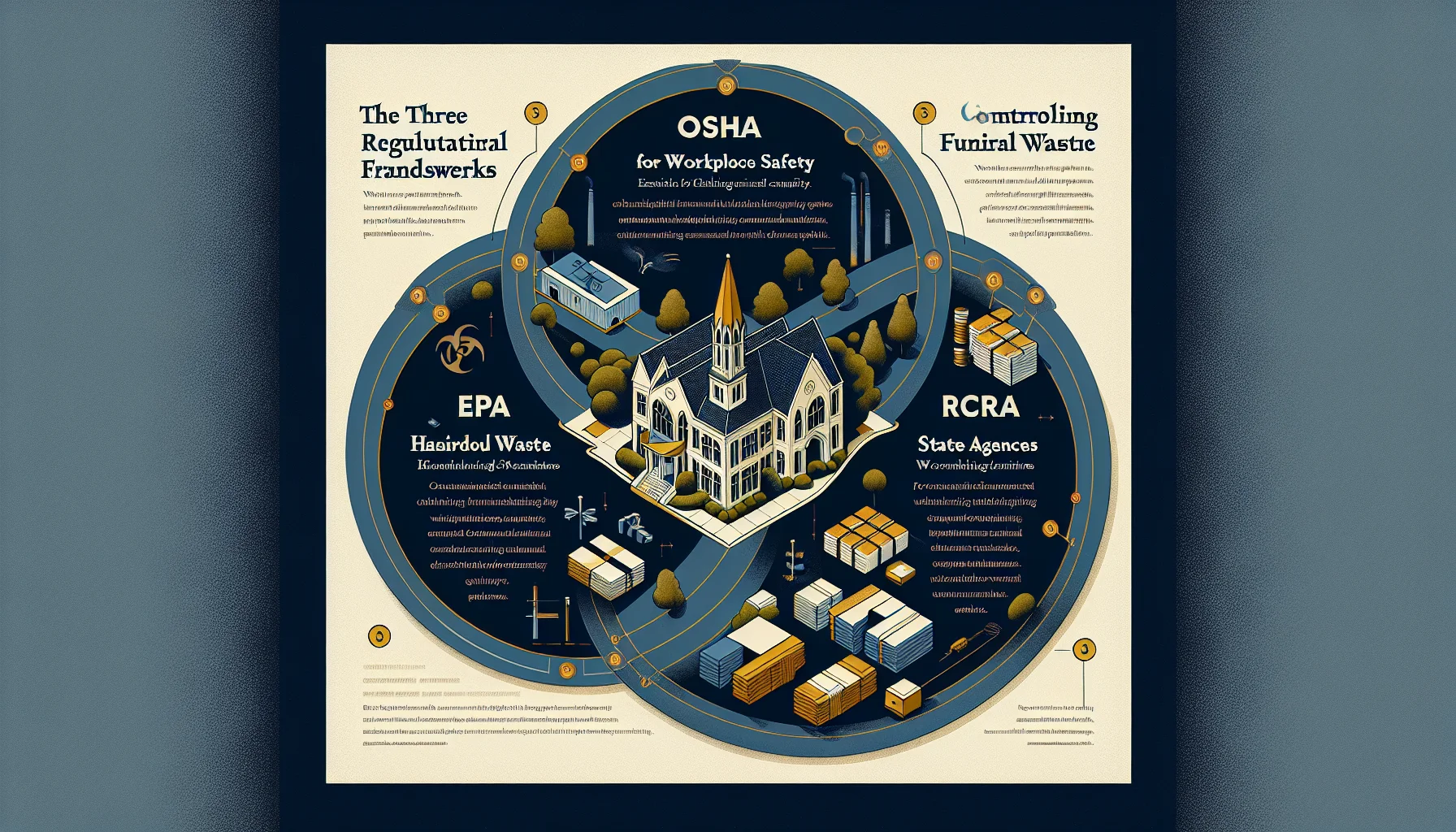
Three separate regulatory frameworks govern these activities: OSHA (workplace safety), EPA/RCRA (hazardous waste), and a patchwork of state and local agencies (wastewater, air quality, environmental remediation). A buyer who ignores any of them is buying blind — and the consequences aren’t theoretical.
The Compliance Landscape Nobody Warned You About
Here’s what most buyers miss: these aren’t separate, siloed compliance areas. They overlap, and a failure in one frequently triggers scrutiny in the others.
OSHA governs the safety of your employees. If your embalming room ventilation is inadequate, that’s an OSHA violation. The EPA governs what leaves your facility — the chemicals you store, the waste you generate, the substances that enter the drain. State agencies layer on top with their own requirements for wastewater discharge, crematory emissions, and environmental site conditions.
The critical distinction for buyers: OSHA violations are citations against the employer. You become the employer at closing. Environmental liabilities attach to the property. If contamination exists, the current owner is liable — and that’s about to be you.
OSHA penalty amounts as of 2025: up to $16,131 per serious violation, up to $161,323 per willful or repeated violation. These adjust annually for inflation. A single inspection finding multiple violations can easily produce a six-figure penalty.
Formaldehyde: The Chemical at the Center of Everything
Formaldehyde is the defining chemical hazard in funeral home operations. It’s classified as a known human carcinogen by the National Toxicology Program and regulated under 29 CFR 1910.1048 — OSHA’s specific formaldehyde standard.
The numbers that matter:
- PEL (Permissible Exposure Limit): 0.75 ppm as an 8-hour time-weighted average
- STEL (Short-Term Exposure Limit): 2 ppm over any 15-minute period
- Action Level: 0.5 ppm TWA — this is the trigger point for increased monitoring and medical surveillance
When formaldehyde exposure reaches or exceeds the action level, employers must provide:
- Initial exposure monitoring within 30 days of operation
- Periodic monitoring every 6 months (every 3 months if above the PEL)
- Annual medical surveillance including health questionnaires
- Pulmonary function testing for respirator wearers
- Quick-drench showers and eyewash stations in any area where splashing is possible
- 30-year retention of exposure and medical records
What to request from the seller
Before closing, you need documentation of:
1. Most recent air monitoring results. If they don’t exist, that’s itself a violation — and a red flag about overall compliance culture.
2. Ventilation specifications for the preparation room. Industry standard is 12–15 air changes per hour minimum. The NFDA recommends downdraft ventilation tables that pull formaldehyde-laden air away from the embalmer’s breathing zone.
3. Employee medical surveillance records. Are annual health questionnaires on file? Has anyone reported symptoms?
4. Training documentation. Every employee exposed to formaldehyde must receive training on health hazards, protective measures, and emergency procedures. Annually.
5. Respirator program documentation — if respirators are used, a complete written respiratory protection program is required under 29 CFR 1910.134.
If the seller cannot produce these records, budget $3,000–$8,000 for a comprehensive exposure assessment and ventilation evaluation immediately post-closing. Do not operate the preparation room without knowing where you stand. Formaldehyde exposure is also one of the primary drivers of expensive workers comp claims from chemical exposure — a factor that directly affects your EMR and annual premium costs.
Hazardous Waste: What RCRA Requires
The Resource Conservation and Recovery Act (RCRA) governs hazardous waste from generation through disposal. Funeral homes generate several categories of regulated waste:
- Formaldehyde solutions and containers — spent embalming fluid, rinsate, contaminated cotton and packing materials
- Biomedical waste — blood, bodily fluids, sharps, tissue, and anything saturated with blood or other potentially infectious materials
- Chemical waste — disinfectants, cleaning solvents, cosmetic chemicals, cavity fluid
Generator classification
Most funeral homes qualify as Very Small Quantity Generators (VSQGs) — producing less than 220 pounds (100 kg) of hazardous waste per month. This is the lightest regulatory tier, but it still carries requirements:
- Proper identification and labeling of all waste containers
- Storage time limits (generally no more than one year for VSQGs)
- Use of licensed hazardous waste haulers with proper manifesting
- Records of all waste shipments
Red flags during due diligence
Walk the facility. Look for these:
- Unmarked or unlabeled containers in the preparation room, storage areas, or near drains. If you can’t identify what’s in a container, neither can an inspector — and you’ll own the cleanup.
- No disposal records. If the seller can’t produce manifests or receipts from a licensed waste hauler, waste has been going somewhere it shouldn’t.
- Drain disposal of embalming waste. This may or may not violate local pretreatment ordinances — but if formaldehyde-containing waste is going down the drain without a permit, you’re inheriting a potential enforcement action.
- Accumulation areas without secondary containment. Spills happen. If there’s no containment, contamination migrates.
Wastewater and Air Quality
Wastewater discharge
Embalming operations generate liquid waste containing formaldehyde, disinfectants, and biological materials. Where this waste goes — and whether you have permission to send it there — depends entirely on your local jurisdiction.
Most municipalities require funeral homes to comply with pretreatment ordinances that limit what can be discharged into the public sewer system. Some require permits. Some require periodic sampling and reporting.
Due diligence action: Contact the local wastewater authority and ask whether the funeral home at your target address holds a discharge permit, and whether that permit is current and in compliance. This is public information and takes one phone call.
Crematory air quality
If the property includes a crematory, add an entire additional layer of regulatory compliance:
- Air quality operating permits — required in most states for crematory operations
- Mercury emissions — dental amalgam in remains releases mercury during cremation, subject to EPA regulation
- Particulate matter — crematory emissions must meet local air quality standards
- Opacity limits — visible emissions from the stack are regulated in most jurisdictions
Crematory equipment must be properly maintained and operated within manufacturer specifications. Retort age matters: older units may not meet current emission standards, and replacement costs $150,000–$400,000+.
Due diligence action: Request copies of all air quality permits. Verify they’re current. Ask when the retort was last inspected and serviced. Check with your state environmental agency for any open enforcement actions at the address.

The Phase I Environmental Site Assessment
If you are purchasing the real estate — not just the business — a Phase I Environmental Site Assessment (ESA) is non-negotiable. This isn’t optional caution; it’s your legal protection.
Under CERCLA (the federal Superfund law), property owners can be held liable for contamination they didn’t cause — unless they qualify for the innocent landowner defense. Qualifying requires conducting “all appropriate inquiries” before purchase. A Phase I ESA conducted under ASTM E1527-21 satisfies this requirement.
What a Phase I covers
- Historical use review — what was on this property before it was a funeral home? Former dry cleaners, gas stations, and industrial sites leave contamination that persists for decades.
- Site inspection — visual assessment of the property and adjacent properties for signs of contamination (staining, distressed vegetation, storage tanks, drums)
- Regulatory database review — federal and state databases of known contamination sites, underground storage tanks, and enforcement actions
- Interviews — with current owners, operators, and local officials
Cost and timeline
- Phase I ESA: $3,000–$5,000, takes 2–4 weeks
- Phase II ESA (if triggered): $10,000–$50,000+, involves soil and groundwater sampling. Triggered when the Phase I identifies “recognized environmental conditions” requiring investigation.
If your SBA lender is financing the real estate, they will almost certainly require a Phase I. But even if they don’t — do it anyway. The cost is trivial compared to the liability you’re assuming.
For a deeper analysis of whether to purchase or lease the real estate, see our real estate strategy guide.
The Complete Environmental Due Diligence Checklist
Before closing, verify or obtain every item on this list:
1. Formaldehyde exposure monitoring records — most recent results, monitoring schedule, any above-action-level readings
2. OSHA 300 logs — injury and illness records for the past 5 years (employers with 10+ employees must maintain these)
3. Hazardous waste manifests — all disposal records for the past 3 years minimum
4. Wastewater discharge permit — current permit and most recent compliance reports
5. Air quality permits — if crematory is present, all operating permits and emission test results
6. Phase I ESA — for real estate purchases, conducted within 180 days of closing
7. Underground storage tank records — if applicable, registration, inspection, and closure documentation
8. Asbestos survey — many older funeral homes contain asbestos in insulation, floor tiles, and pipe wrapping. A survey costs $500–$2,000.
9. Lead paint assessment — for buildings constructed before 1978
10. State environmental agency records search — check for open investigations, consent orders, or cleanup requirements at the property address
Any item the seller cannot produce is a gap you need to fill before — or immediately after — closing. Budget accordingly.
What Non-Compliance Actually Costs
The financial exposure from environmental and safety non-compliance dwarfs most other due diligence risks:
OSHA penalties:
- Serious violation: up to $16,131 per violation
- Willful or repeated: up to $161,323 per violation
- A single inspection can cite multiple violations. Five serious violations = $80,000+ before you negotiate.
EPA/RCRA penalties:
- Up to $70,117 per day per violation for hazardous waste non-compliance
- Criminal penalties possible for knowing violations — including imprisonment
Environmental remediation:
- Soil contamination cleanup: $100,000–$500,000+ depending on extent
- Groundwater contamination: $500,000–$2,000,000+, potentially more
- These costs attach to the property owner regardless of who caused the contamination
Litigation exposure:
- Employee formaldehyde exposure claims — cancer diagnosis linked to workplace exposure can generate seven-figure settlements. Adequate insurance coverage is essential to protect against these claims.
- Wrongful death claims from occupational exposure
- Third-party environmental contamination claims from neighboring properties
For context on how this fits into your broader risk management strategy, environmental compliance is the one area where the cost of prevention is genuinely trivial compared to the cost of failure.
Negotiation Leverage
Environmental findings aren’t just risks — they’re negotiation tools.
If your due diligence uncovers compliance gaps, you have three options:
1. Price adjustment. Quantify the cost to achieve compliance (ventilation upgrades, waste disposal setup, monitoring programs) and negotiate that amount off the purchase price.
2. Seller remediation. Require the seller to achieve compliance before closing. Get this in writing with specific standards and verification.
3. Escrow holdback. Set aside a portion of the purchase price in escrow to cover identified environmental issues, released when remediation is complete.
The key is documentation. An environmental consultant’s report quantifying the issues gives you specific numbers to negotiate against — not vague concerns.
Building Your Compliance Program Post-Closing
Once you close, compliance becomes your daily responsibility. Build these systems in your first 90 days:
- Hire a qualified environmental consultant for an initial comprehensive assessment if the seller’s records were incomplete
- Establish a formaldehyde monitoring schedule — quarterly until you have a year of data showing consistent below-action-level results
- Set up a hazardous waste management program — properly labeled containers, licensed hauler under contract, manifest tracking system
- Train every employee on chemical hazards, emergency procedures, and their rights under OSHA’s Hazard Communication Standard
- Document everything. Inspections, monitoring results, training sessions, equipment maintenance. If it isn’t written down, it didn’t happen — and OSHA will treat it that way.
Frequently Asked Questions
Do I need a Phase I ESA if I’m only buying the business, not the building?
If you’re leasing, a Phase I isn’t legally required for your protection — but it’s still worth asking the landlord for a copy. Environmental contamination at the property can disrupt your operations even if you don’t own the building. And if you have any option to purchase the real estate later, you’ll want a baseline assessment.
The seller says they’ve never had an OSHA inspection. Is that good news?
It means you have no data. An estimated 60–70% of funeral homes have never been formally inspected by OSHA. That doesn’t mean they’re compliant — it means compliance has never been tested. Treat the absence of inspections as an absence of information, not evidence of compliance.
How much should I budget for bringing a non-compliant facility into compliance?
Varies widely. A facility with adequate ventilation that just needs monitoring and documentation: $5,000–$10,000 to establish programs. A facility with inadequate ventilation requiring a downdraft table and ductwork modification: $15,000–$40,000. A facility with significant environmental contamination: six figures. Get a professional assessment before closing.
Does environmental compliance affect my SBA loan approval?
Yes. SBA lenders conduct environmental reviews as part of their underwriting for loans involving real estate. A clean Phase I is typically required. If Phase II testing is triggered, the loan process will pause until results are available. Known contamination can be a loan-killer unless the remediation path is clear and funded.
What about crematory-specific regulations?
Crematories add a substantial compliance layer: air quality permits, emission testing, mercury management, and potentially local zoning restrictions on crematory operations. If the acquisition includes a crematory, budget an additional $5,000–$15,000 for a crematory-specific compliance audit. The regulatory requirements vary significantly by state — some states have prescriptive standards, others defer to general air quality rules.
One fast-moving regulatory dimension deserves its own treatment: the A2L refrigerant compliance cliff created by the AIM Act’s HFC phasedown. Mortuary coolers running on legacy refrigerants carry a five-figure capex liability most buyers miss.
Environmental compliance isn’t the most exciting part of funeral home acquisition due diligence. But it’s the one area where ignorance can cost you more than the business itself. A $4,000 Phase I ESA and a $5,000 compliance audit are trivial investments against six-figure liabilities. Do the work before you sign.